
(Tentative)
| Function | Reference Model | Input/Output Data |
| SubAIMs | JSON Metadata | Profiles |
1. Function
Prompt Creation AIM (PGM-PRC)
- Receives
- Context
- Audio and Visual Scene Descriptors from Audio and Visual Spatial Reasoning AIMs and, indirectly, Domain Access (PGM-DAC).
- Prompt Creation Directive from A-User Control.
- Synthesises these multimodal and contextual signals into coherent natural language prompts that describe the User’s interaction, clarify intent, and confirm inferred goals.
- Provides
- Textual PC-Prompt to Basic Knowledge LLM.
- Prompt Creation Statusto A-User Control.
The resulting outputs enable A-User Control, Personality Alignment, and Rendering AIMs to operate with full awareness of the User’s communicative intent, supporting expression coherence, goal-driven orchestration, and context-sensitive interaction.
2. Reference Model
Figure 1 gives Reference Model of Prompt Creation (PGM-PRC).
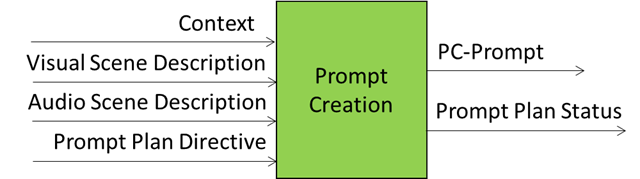
Figure – The Reference Model of Prompt Creation (PGM-PRC)
3. Input/Output Data
Table 1 – Input/Output Data of PGM-PRC
| Input | Description |
| Context | A structured and time-stamped snapshot representing the initial understanding that the A-User achieves of the environment and of the User posture. |
| Audio Scene Descriptors | A Data Type that conveys spatially grounded semantic audio data from the Spatial Reasoning AIM that enables the Prompt Construction AIM to generate context-aware and referentially precise prompts. |
| Visual Scene Descriptors | A Data Type that conveys spatially grounded semantic visual data from the Spatial Reasoning AIM that enables the Prompt Construction AIM to generate context-aware and referentially precise prompts. |
| Prompt Creation Directive | Trigger to initiates prompt generation or refinement from PGM-AUC. |
| Output | Description |
| PC-Prompt | Prompt to Basic Knowledge |
| Prompt Creation Status | Prompt readiness, alignment status, and semantic goal framing to PGM-AUA. |
4. SubAIMs
The identification of SubAIMs is based on the following steps:
- Structure the Response
The initial natural language output needs to be converted into a structured format (DA Input) so downstream modules can process it reliably. - Ensure Multimodal Consistency
Items referenced in the prompt must match what’s detected in audio and visual scenes—avoiding ambiguity and grounding the interaction. - Validate Domain Rules and Constraints
Before planning any action, the Prompt Creation checks compliance with operational, safety, and domain-specific rules to prevent invalid behaviours. - Assess Zone Feasibility
Actions often depend on spatial zones (e.g., reachable areas). Verifying zone feasibility ensures the intended behaviour is physically or logically possible. - Confirm Scene Integrity
Scene consistency checks prevent mismatches between what the Prompt Creation thinks the environment is and what it actually is. - Select Appropriate Behaviours
From validated context and user state, candidate behaviours are retrieved to align with the User’s goals and domain logic. - Check Execution Feasibility
Even valid behaviours must be executable under current constraints to ensure practical feasibility before committing. - Provide Fallback Options
If execution isn’t feasible, fallback actions or adjusted prompts are generated to keep the interaction flowing without failure. - Prepare a Structured PC-Prompt Plan
The final output is a PC-Prompt Plan that integrates all validated context, constraints, and behaviours for subsequent natural language generation. - Produce PC-Prompt
Convert the PC-Prompt into natual language prompt..
Figure 2 identifies a possible partitioning of SubAIMs.
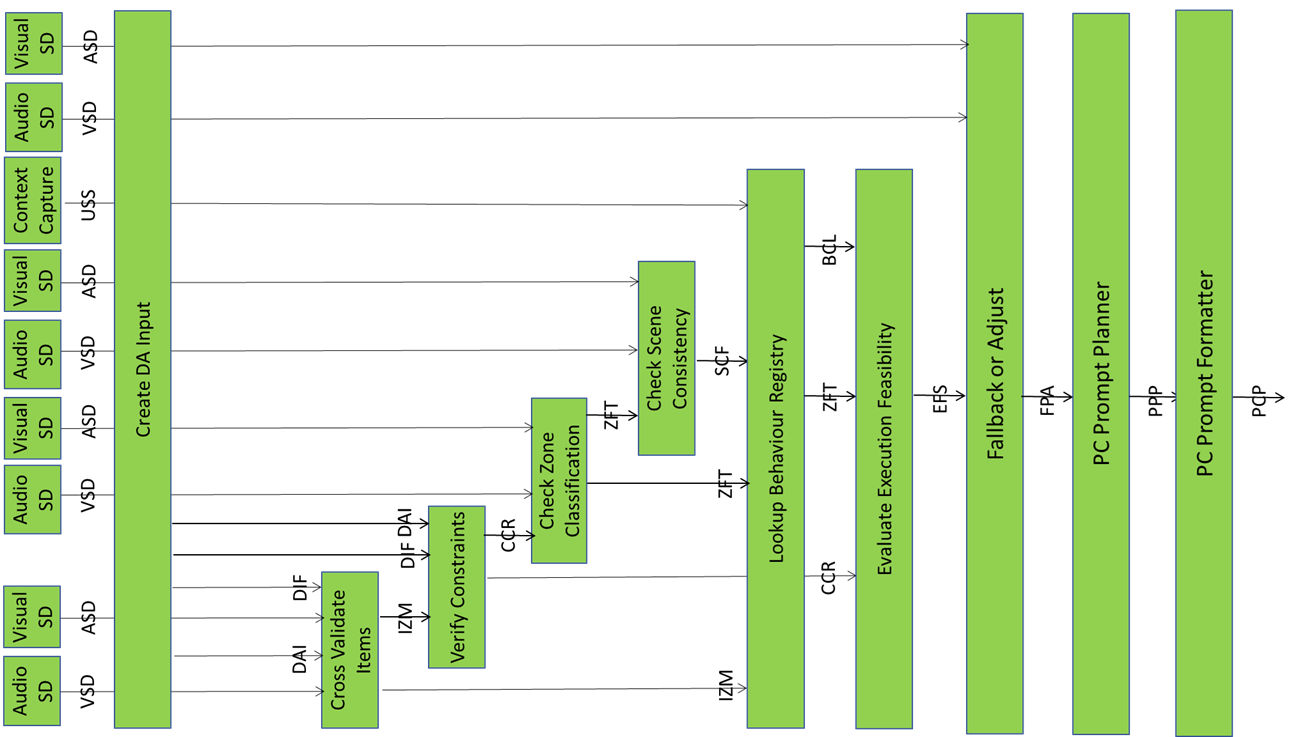
Figure 2 – Reference Model of Prompt Creation Composite (PGM-PRC) AIM
For graphical reasons, Data Types are identified by three-letter acronyms
| ASD | Audio Scene Descriptors | IRS | Initial Response |
| BCL | Behaviour Candidates List | IZM | Item Zone Match |
| CCR | Constraint Check Result | PPP | PC-Prompt Plan |
| DAI | DA-Input | SCF | Scene Consistency Flag |
| DIF | DA-Input Flag | USS | User State |
| EFS | Execution Feasibility Status | VSD | Visual Scene Descriptors |
| FPA | Fallback Prompt Action | ZFT | Zone Feasibility Tag |
Table 2 defines a possible set of SubAIMs for PGM-PRC
Table 2 – Potential SubAIMs for PGM-PRC
| Sub-AIM | Function | Inputs | Outputs | To | Description |
| CDI | Create DA Input | Initial Response | DA Input; DA Input Flags | CVI, VFC, CSC, LTM | Converts natural language response into structured JSON and generates flags for constraint checks. |
| CVI | Cross Validate Items | DA Input; ASD; VSD | Item Zone Match | VFC | Confirms item positions and associations across audio and visual descriptors for multimodal consistency. |
| VFC | Verify Constraints | DA Input Flags; ASD; VSD; Item Zone Match | Constraint Check Result | CZC, EEF | Checks compliance with domain rules and operational constraints using multimodal context and validation flags. |
| CZC | Check Zone Classification | ASD; VSD; Constraint Check Result | Zone Feasibility Tag | CSC, EEF | Determines whether zones are feasible for intended actions based on spatial and audio descriptors. |
| CSC | Check Scene Consistency | SceneID (DA Input); SceneID (Spatial Reasoning); Zone Feasibility Tag | Scene Consistency Flag | LBR | Validates that the scene context matches expected spatial and logical structure for safe execution. |
| LBR | Lookup Behaviour Registry | User State; Item Zone Match; Scene Consistency Flag | Behaviour Candidates List | EEF | Retrieves candidate behaviors from a registry based on user state and validated scene context. |
| EEF | Evaluate Execution Feasibility | Behaviour Candidates List; Constraint Check Result; Zone Feasibility Tag | Execution Feasibility Status | FBA, EEP | Assesses whether candidate behaviours can be executed under current constraints and zone conditions. |
| FBA | Fallback or Adjust | Execution Feasibility Status; ASD; VSD | Fallback Prompt Action | PCP (PC Prompt Planner) | Generates alternative actions or fallback prompts when execution feasibility fails. |
| EEP | Emit Execution Payload | Execution Feasibility Status; Behaviour Candidates List | Execution Payload Object | PAL, USR | Produces the final structured payload for execution, including selected behaviour and feasibility metadata. |
| LTM | Log Trace Metadata | DA Input ID; ASD ID; VSD ID; Execution Feasibility Status | Trace Provenance Log | AUC | Records provenance and traceability data for auditing and lifecycle management. |
5. JSON Metadata
https://schemas.mpai.community/PGM1/V1.0/AIMs/PromptCreation.json
6. Profiles
No Profiles.