

While the Basic Knowledge module is a generalist language model that “knows a bit of everything”, Domain Access is the expert with a broad range of knowledge that enables the Autonomous User to tap into domain-specific intelligence for deeper understanding.
We have already presented the system diagram of the Autonomous User (A-User), an autonomous agent able to move and interact (walk, converse, do things, etc.) with another User in a metaverse. The latter User may be an A-User or be under the direct control of a human and is thus called a Human-User (H-User). The A-User acts as a “conversation partner in a metaverse interaction” with the User.
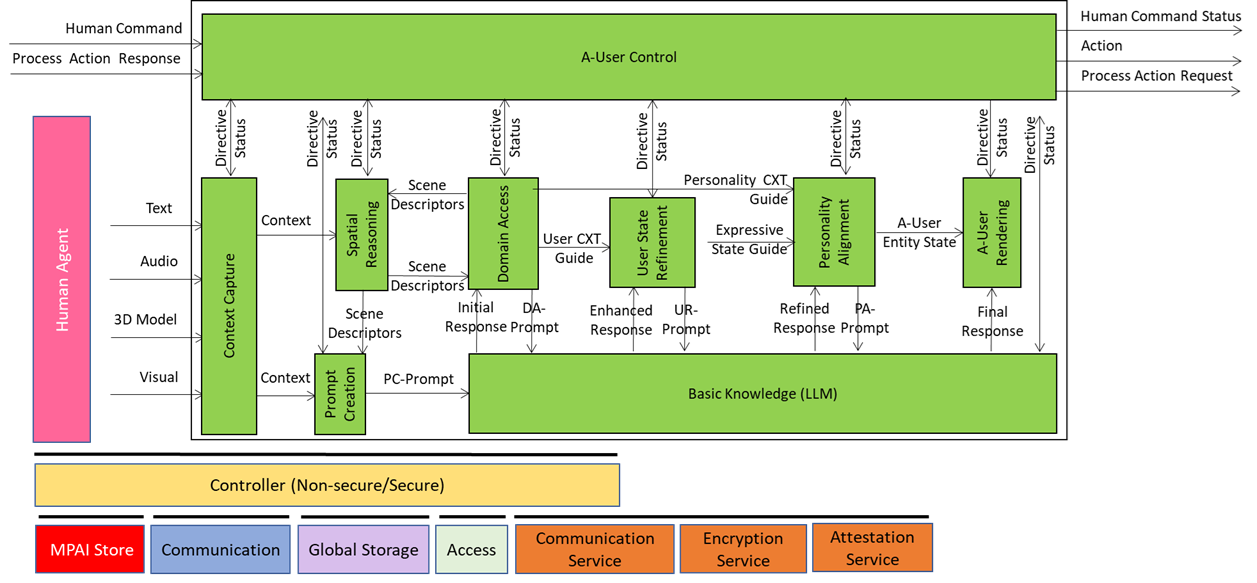
This is the sixth of a sequence of posts aiming to illustrate the architecture of an A-User and provide an easy entry point for those who wish to respond to the MPAI Call for Technology on Autonomous User Architecture. The first five dealt with 1) the Control performed by the A-User Control AI Module on the other components of the A-User; 2) how the A-User captures the external metaverse environment using the Context Capture AI Module; 3) listens, localises, and interprets sound not just as data, but as data having a spatially anchored meaning; 4) makes sense of what the Autonomous User sees by understanding objects’ geometry, relationships, and salience; and 5) takes raw sensory input and the User State and turns them into a well‑formed prompt that Basic Knowledge can actually understand and respond to.
The Basic Knowledge module is a generalist language model that “knows a bit of everything.” In contrast, Domain Access is the expert layer that enables the Autonomous User (A-User) to tap into domain-specific intelligence for deeper understanding of user utterances and their context.
How Domain Access Works
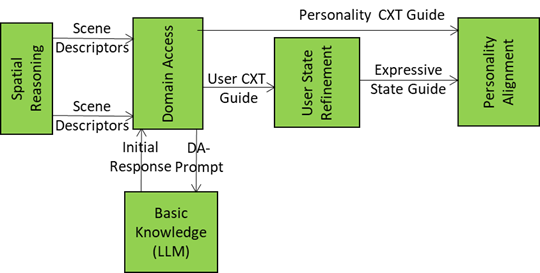
- Receives Initial Response: Domain Access starts with the response of Basic Knowledge, the generalist model’s response to the prompt generated by Prompt Creation.
- Converts to DA-Input: As the natural language response is not the best way to process the response, it is converted into a JSON object called DA-Input for structured processing.
- Gets domain knowledge by pulling in domain vocabulary such as, jargon and technical terms.
- Creates the next prompt by using this specialised knowledge:
- Injects rules and constraints (e.g., standards, legal compliance).
- Adds reasoning patterns (e.g., diagnostic flows, contractual logic).
All enrichment happens in the JSON domain and so is the produced DA-Prompt Plan – a domain-aware structure ready for conversion into natural language – called DA-Prompt – and resubmission into the knowledge/response pipeline.
Why Domain Access Matters
Without Domain Access, the A-User is like a clever intern: knowledgeable but lacking depth and experience. With Domain Access, it becomes n experienced professional that can:
- Deliver accurate, context-aware answers.
- Avoid hallucinations by grounding responses in domain rules.
- Address different application domains by swapping or adding domain modules without rebuilding the entire A-User.
What you can take away about Domain Access
- Get Initial Response from Basic Knowledge.
- Convert to DA-Input (JSON).
- Enrich with Domain Context:
- Pull in domain vocabulary.
- Inject rules and constraints.
- Add reasoning patterns.
- Create DA-Prompt Plan (domain-aware structure).
- Translate to DA-Prompt (natural language).
- Query Basic Knowledge language model.
- Strong points
- Deliver accurate, context-sensitive answers.
- Avoid hallucinations via domain grounding.
- Adapt across different domains by swapping modules.