
<-References Go to ToC Full-Trust Requirements ->
1. Introduction
Technical Specification: Process Instance Trust Framework (MPAI-PTF) V1.0 defines the architectural components and trust relationships enabling Process Instances to establish trust in distributed and zero‑trust environments. The Architecture specifies the roles, data structures, and interactions required for a Process Instance to present verifiable identity, credentials, and evidence, and for another Process Instance to evaluate these elements against a Policy Binding to derive a Trust Decision.
The PTF Architecture is composed of the following elements:
| Element | Definition |
|---|---|
| Process Instance | An AI Module (per the MPAI-AIF standard) or a Process (per the MMM-TEC standard) that participates in trust establishment by presenting its Cryptographic Instance Identity, Instance Credential, and Attestation Evidence. A Process Instance may request trust from another Process Instance or evaluate trust requests it receives. |
| Cryptographic Instance Identity | A structured representation of the cryptographic identity of a Process Instance. The CII includes the public key and associated metadata required to verify signatures and bind the identity to an Instance Credential. |
| Instance Credential | A signed object binding a Process Instance’s Cryptographics Instance Identity to a Trust Anchor. The Instance Credential asserts the validity of the identity and may include attributes relevant to trust evaluation. |
| Trust Anchor | An entity whose public key is trusted to issue or validate Instance Credentials. Trust Anchors form the root of trust in PTF and may be managed by governance processes external to this Technical Specification. |
| Attestation Evidence | Information describing the state, configuration, or behaviour of a Process Instance. Evidence Items are typed according to the Security Evidence Taxonomy and may be signed or unsigned. Evidence supports the evaluation of trust policies. |
| Policy Binding | A structured set of requirements defining the trust conditions that a Process Instance must satisfy. A Policy Binding may specify required Trust Anchors, cryptographic algorithms, evidence types, attributes, and validity constraints. |
| Trust Protocol | The set of messages and procedures enabling Process Instances to exchange identity, credentials, evidence, and trust decisions. The Trust Protocol defines the TrustRequest and TrustResponse messages and the rules governing their use. |
| Verification Pipeline | The ordered set of procedures applied to a TrustRequest to derive a Trust Decision. The Verification Pipeline includes schema validation, credential verification, evidence verification, and policy evaluation. |
Trust Establishment Model
Trust establishment in PTF follows a request–response model:
- A Trust Anchor provides the means to negotiate Trust in a service-oriented Request/Response paradigm.
- A Requester Process Instance creates a TrustRequest containing its Cryptographic Instance Identity, Instance Credential, and Attestation Evidence.
- The Requester Process Instance sends the TrustRequest to its Trust Anchor.
- Trust Anchor makes the TrustRequest Trusted.
- The Requester Process Instance sends the TrustedRequest to a ResponderProcess Instance .
- The Responder Process Instance sends the Trusted Request to its Trust Anchor.
- Trust Anchor informs the Responder of the Trust worthiness of the received TrustedRequest.
- The Responder prepares a TrustResponse indicating acceptance, rejection, or conditional trust, optionally including its own identity and credentials.
- The Responder sends its prepared TrustResponse to its Trust Anchor.
- The Trust Anchor applies the Verification Pipeline to the received TrustResponse.
- The Trust Anchor sends the verified Trust Response to Responder.
- Responder issues a TrustResponse indicating.
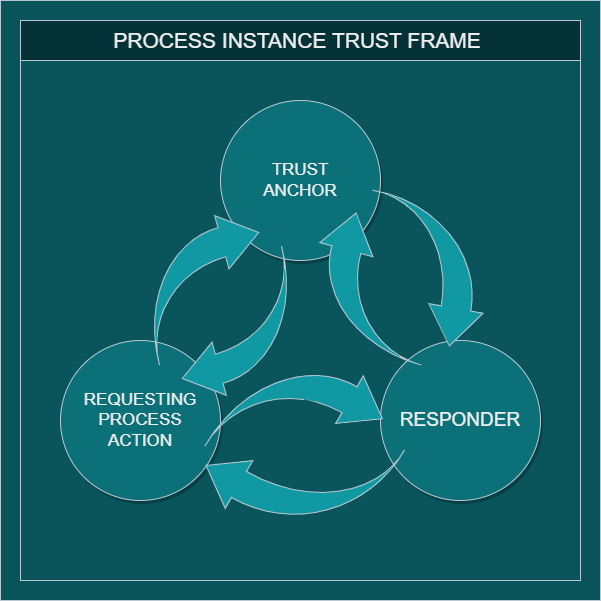
This model supports:
- Out-of-band trust establishment.
- Mutual authentication, authentication, and acceptance (Triple A), where both parties independently evaluate each other.
- Policy‑driven negotiation, where trust depends on satisfying specific requirements.
Distributed and Zero‑Trust Operation
The PTF Architecture supports operation in:
- Local environments, where Process Instances execute on the same platform.
- Distributed environments, where Process Instances communicate across networks.
- Full-Trust Environments, (see definition).
In all cases, trust must be established through verification of identity, credentials, evidence, and policy.
Interoperability
The Architecture enables interoperability across independent implementations by standardising:
- Identity representation
- Credential structure
- Evidence types
- Policy requirements
- Trust Protocol messages
- Verification procedures
Implementations may differ internally but must conform to the normative structures and procedures defined in this Technical Specification.
2. Actors
| Actor | Definition |
|---|---|
| Requester Process Instance | A Process Instance that initiates trust establishment by sending a TrustRequest containing its identity, credentials, and evidence. |
| Responder Process Instance | A Process Instance that receives a TrustRequest and applies its Verification Pipeline to derive a Trust Decision. |
| Trust Anchor | An entity that converts – A TrustRequest into a Trusted Request and informs of the trust-worthiness of a received TrustRequest exchanging Credentials resulting from out-of-band trust negotiation. – A TrustResposeinto a Trusted Response and informs of the trust-worthiness of a received TrustResponse exchanging Credentials resulting from out-of-band trust negotiation. |
| Evidence Provider | A component or service that generates Attestation Evidence describing the state or behaviour of a Process Instance. |
| Policy Authority | An entity that defines or manages Policy Bindings used by Process Instances to evaluate trust. |
3. Actions and Contexts
A Trust Request is generally made because a Requester Process Instance seeks to establish trust with a Responder Process Instance for the purpose of engaging in a specific interaction.
Conceptually, the requested interaction may be represented as: Action + Context,
where:
- Action identifies the operation requested of the Responder Process Instance.
- Context is structured information accompanying the Action and required by a Trust Authority to evaluate whether trust may be established between the participating Process Instances for the requested interaction.
The Context may include:
- Referenced entities, resources, processes, Items, or data.
- Input and output objects associated with the Action.
- Requested or proposed state changes.
- Proposed rights, permissions, obligations, or prohibitions.
- Proposed transactions or exchanges of value.
- Operational, temporal, environmental, or governance information.
- Any additional information required by applicable policies.
A Trust Authority may use the Action and Context together with identities, credentials, attestation evidence, policy bindings, verification profiles, trust anchors, and out-of-band information to evaluate:
- Whether the Requester Process Instance is a credible requester of the Action in the specified Context.
- Whether the Responder Process Instance is an appropriate target for the requested Action.
- Whether the requested interaction complies with applicable policies and constraints.
- Whether any proposed future state resulting from successful execution of the Action is acceptable.
The Context may include descriptions of a proposed future state that does not yet exist at the time of the request. Examples include requested rights, proposed obligations, proposed commitments, proposed transactions, or other requested state changes. Such elements are not established facts. Rather, they are requested outcomes whose acceptability may be considered during trust evaluation.
If trust is established, the participating Process Instances may proceed with the requested interaction and exchange information accompanied by Data Exchange Metadata (DEM). DEM conveys information governing the use of exchanged information after trust has been established. DEM may include authorisations, legal constraints, security requirements, provenance information, annotation integrity requirements, retention requirements, and other metadata needed to support compliant, auditable, and traceable use of exchanged information.
If trust cannot be established, the requested interaction shall not proceed and no proposed future state described in the Context shall take effect.
4. Trust Relationships
The PTF Architecture defines trust relationships among Process Instances and supporting entities. These relationships are established through the verification of identity, credentials, evidence, and policy.
| Relationship | Description |
|---|---|
| Identity Trust | A Process Instance trusts that another Process Instance is correctly identified when its Cryptographic Instance Identity and Instance Credential are valid and issued by a trusted Trust Anchor. |
| Credential Trust | A Process Instance trusts that the identity and attributes of another Process Instance are valid when its Instance Credential is verified against the Trust Anchor. |
| Evidence Trust | A Process Instance trusts the state or behaviour of another Process Instance when its Attestation Evidence is valid, fresh, and consistent with the Security Evidence Taxonomy. |
| Policy Trust | A Process Instance trusts another Process Instance when the received identity, credentials, and evidence satisfy the requirements defined in its Policy Binding. |
| Mutual Trust | Two Process Instances independently verify each other’s identity, credentials, and evidence, resulting in bilateral trust establishment. |