
<-Trust Establishment Protocol Go to ToC End‑to‑End Examples->
1. Requirements
1.1 Overview
This chapter defines the requirements for conformance to the MPAI‑PTF Trust Framework.
A conforming implementation shall:
- correctly process all mandatory PTF data types
- correctly execute the Verification Pipeline
- correctly enforce Zero‑Trust requirements
- correctly apply security and policy constraints
- correctly generate and validate Trust Messages
- correctly handle post‑trust Data Exchange Metadata (DEM)
Conformance applies to implementations, components, and PTF objects.
1.2 Conformance Classes
PTF defines four conformance classes:
1.2.1 Verifier
An implementation that performs the Verification Pipeline and produces TrustResponses.
A conforming Verifier shall:
- implement all mandatory verification steps
- validate all PTF data types
- enforce policies and profiles
- generate TrustOperations
- sign TrustResponses
1.2.2 Process Instance (PI)
An implementation that participates in trust establishment and data exchange.
A conforming PI shall:
- generate valid CII
- provide valid credentials and evidence
- respond to TrustRequests
- enforce DEM authorisations and legality constraints
1.2.3 Policy Authority
An implementation that issues policies and trust anchors.
A conforming Policy Authority shall:
- generate valid PolicyBinding objects
- sign policies using SAT algorithms
- maintain trust anchors
1.2.4 Data Producer / Consumer
An implementation that exchanges data after trust is established.
A conforming Data Producer/Consumer shall:
- generate valid DEM
- enforce DEM authorisations
- preserve provenance and annotations
1.3 Data Type Conformance
A conforming implementation shall:
1.3.1 General
- accept all mandatory fields
- reject undeclared fields
- validate all signatures using SAT
- validate all timestamps and validity intervals
- validate all identifiers and taxonomies
1.3.2 Specific Data Types
| Data Type | Conformance Requirements |
|---|---|
| CII | Must be signed; must include valid roles; must use SAT algorithms |
| InstanceCredential | Must be signed; must bind to a valid CII; must include validity interval |
| ProcessLifecycleCredential | Must reflect correct lifecycle state; must be signed |
| AttestationEvidence | Must use SET types; must include hash + signature; must include freshness indicators |
| PolicyBinding | Must be signed; must bind to correct target; must reference valid profiles |
| VerificationProfile | Must define deterministic rules; must reference valid taxonomies |
| TrustMessage | Must be signed; must include MessageType; must include Request or Response |
| TrustOperation | Must be generated for each verification step; must be signed |
| DataExchangeMetadata (DEM) | Must include DataID and Source; must include authorisations; must include legality/security metadata |
1.4 Verification Pipeline Conformance
A conforming Verifier shall implement all of the following steps:
- Request Intake
- Identity Verification
- Credential Verification
- Evidence Verification
- Policy Evaluation
- Decision Logic
- TrustResponse Generation
- TrustOperation Logging
Each step shall:
- validate all required data types
- reject malformed or unverifiable objects
- produce a TrustOperation entry
A conforming Verifier shall not skip or reorder mandatory steps.
1.5 Security Conformance
A conforming implementation shall:
1.5.1 Cryptography
- use only SAT‑approved algorithms
- reject deprecated or weak algorithms
- validate all signatures and hashes
1.5.2 Freshness
- validate timestamps
- validate validity intervals
- reject stale evidence or credentials
1.5.3 Non‑repudiation
- sign TrustResponses
- sign TrustOperations
1.5.4 Zero‑Trust Enforcement
- assume no PI, credential, or message is trusted by default
- require explicit verification for all trust decisions
1.6 Policy Conformance
A conforming implementation shall:
- authenticate PolicyBinding objects
- enforce VerificationProfile rules deterministically
- reject trust establishment if any policy fails
- ensure policy evaluation cannot be bypassed
1.7 Trust Protocol Conformance
A conforming implementation shall:
- generate valid TrustRequests
- generate valid TrustResponses
- sign all TrustMessages
- include timestamps to prevent replay
- reject unsigned or tampered messages
1.8 Data Exchange Conformance (Post‑Trust)
A conforming implementation shall:
- generate valid DEM for all exchanged data
- enforce DEM authorisations
- enforce legality constraints
- enforce security metadata
- preserve provenance and annotations
1.9 Interoperability Conformance
A conforming implementation shall:
- accept any valid PTF object from any conforming implementation
- produce PTF objects that other conforming implementations can process
- use only normative taxonomies and schemas
1.10 Conformance Testing
A conforming implementation shall pass:
- structural validation of all PTF data types
- cryptographic validation tests
- pipeline execution tests
- policy enforcement tests
- DEM enforcement tests
- interoperability tests
A Conformance Test Suite outline is provided in the next chapter.
Here are the three deliverables you requested — all clean, structured, and ready to drop into your Conformance chapter.
1.11. Conformance Summary Table
This table gives a one‑page overview of everything a conforming implementation must satisfy.
PTF Conformance Summary
| Conformance Area | Requirements | Applies To |
|---|---|---|
| Data Types | Validate structure, reject undeclared fields, verify signatures, timestamps, validity intervals | Verifier, PI |
| Verification Pipeline | Implement all 8 mandatory steps; produce TrustOperations; deterministic evaluation | Verifier |
| Security | Use SAT algorithms; enforce freshness; sign TrustResponses and TrustOperations | Verifier, PI |
| Zero‑Trust | Assume no trust by default; require explicit verification | Verifier |
| Policies | Authenticate PolicyBinding; enforce VerificationProfile rules; prevent bypass | Verifier |
| Trust Protocol | Generate valid TrustRequests/Responses; sign all messages; prevent replay | Verifier, PI |
| Data Exchange (DEM) | Generate valid DEM; enforce authorisations, legality, security metadata | PI, Data Producer/Consumer |
| Interoperability | Accept valid PTF objects; produce interoperable objects; use normative schemas | All implementations |
| Auditability | Produce signed TrustOperations for each verification step | Verifier |
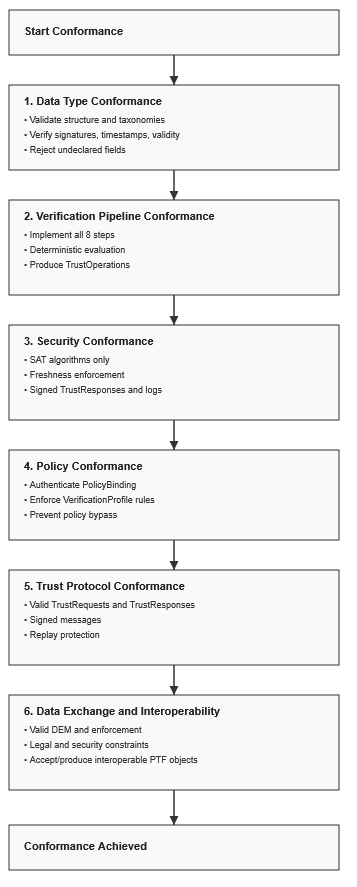
2. Conformance Flow Diagram
This diagram shows the full conformance lifecycle from object validation to interoperability.
3.Conformance Testing
3.1. Conventions
- SUT: System Under Test (Verifier, PI‑A, PI‑B).
- TR: TrustRequest.
- TResp: TrustResponse.
- Status:
"Success"or"Failure". - Reason: failure reason string as per Reference Pseudocode.
All tests assume a single Verifier, one PI‑A, one PI‑B, and a Policy Authority unless stated otherwise.
3.2. Identity Verification Tests (ID‑xx)
ID‑01 — Valid Identity
- Purpose: Verify success when CII and roles are valid.
- Preconditions:
- CII for PI‑B is valid, signed by trusted anchor.
- Role
PTF-CII-ROLE-DATA-CONSUMERis present and required for operationReceiveDatasetX.
- Inputs:
- TR:
TargetID = PI‑B,Operation = ReceiveDatasetX. - Valid CII, credentials, evidence, policy, profile.
- TR:
- Execution:
- PI‑A sends TR to Verifier.
- Verifier runs full pipeline.
- Expected Results:
- Identity step: pass.
- Final TResp:
Status = Success,Reason = null. - PI‑A sends Data + DEM.
ID‑02 — Invalid CII Signature
- Purpose: Verifier rejects invalid CII signature.
- Preconditions:
- CII for PI‑B has tampered signature.
- All other inputs valid.
- Inputs:
- TR as in ID‑01.
- CII with invalid signature.
- Execution:
- PI‑A sends TR.
- Verifier processes.
- Expected Results:
- Identity step fails with
InvalidCIISignature. - TResp:
Status = Failure,Reason = "InvalidCIISignature". - No further steps executed.
- PI‑A sends no data.
- Identity step fails with
ID‑03 — Missing Required Role
- Purpose: Verifier enforces required role for operation.
- Preconditions:
- CII valid but PI‑B lacks required role for
ReceiveDatasetX. - All other inputs valid.
- CII valid but PI‑B lacks required role for
- Inputs:
- TR as in ID‑01.
- CII without required role.
- Execution:
- PI‑A sends TR.
- Expected Results:
- Identity step fails with
MissingRequiredRole. - TResp:
Status = Failure,Reason = "MissingRequiredRole". - No data sent.
- Identity step fails with
ID‑04 — Unknown Role Taxonomy
- Purpose: Verifier rejects roles outside taxonomy.
- Preconditions:
- CII includes role not in Cryptographic Instance Role Taxonomy.
- All other inputs valid.
- Inputs:
- TR as in ID‑01.
- CII with unknown role.
- Execution:
- PI‑A sends TR.
- Expected Results:
- Identity step fails with
UnknownRole. - TResp:
Status = Failure,Reason = "UnknownRole". - No data sent.
- Identity step fails with
3.3. Credential Verification Tests (CR‑xx)
3.3.1 CR‑01 — Valid Credentials
- Purpose: Verify success when credentials are valid.
- Preconditions:
- CII valid.
- InstanceCredential and PLC valid, signed, not expired.
- Issuer trusted.
- Inputs:
- TR as in ID‑01.
- Valid credentials, evidence, policy, profile.
- Execution:
- PI‑A sends TR.
- Expected Results:
- Identity and credential steps pass.
- Final TResp:
Status = Success. - Data + DEM sent.
3.3.2 CR‑02 — Missing InstanceCredential
- Purpose: Verifier rejects missing InstanceCredential.
- Preconditions:
- No InstanceCredential for PI‑B.
- All other inputs valid.
- Inputs:
- TR as in ID‑01.
- Execution:
- PI‑A sends TR.
- Expected Results:
- Credential step fails with
MissingInstanceCredential. - TResp:
Status = Failure,Reason = "MissingInstanceCredential". - No data sent.
- Credential step fails with
3.3.3 CR‑03 — Expired InstanceCredential
- Purpose: Verifier rejects expired credential.
- Preconditions:
- InstanceCredential validity interval ended before TR timestamp.
- All other inputs valid.
- Inputs:
- TR as in ID‑01.
- Expired InstanceCredential.
- Execution:
- PI‑A sends TR.
- Expected Results:
- Credential step fails with
ExpiredInstanceCredential. - TResp:
Status = Failure. - No data sent.
- Credential step fails with
4.4.4 CR‑04 — Invalid InstanceCredential Signature
- Purpose: Verifier rejects tampered credential.
- Preconditions:
- InstanceCredential signature invalid.
- All other inputs valid.
- Inputs:
- TR as in ID‑01.
- Execution:
- PI‑A sends TR.
- Expected Results:
- Credential step fails with
InvalidInstanceCredentialSignature. - No data sent.
- Credential step fails with
3.3.5 CR‑05 — Invalid PLC Lifecycle State
- Purpose: Verifier enforces PLC state.
- Preconditions:
- PLC state ≠
"Running"(e.g.,"Stopped"). - All other inputs valid.
- PLC state ≠
- Inputs:
- TR as in ID‑01.
- Execution:
- PI‑A sends TR.
- Expected Results:
- Credential step fails with
InvalidLifecycleState. - No data sent.
- Credential step fails with
3.3.6 CR‑06 — Untrusted Credential Issuer
- Purpose: Verifier rejects untrusted issuer.
- Preconditions:
- InstanceCredential issuer not in TrustAnchors and no valid chain.
- All other inputs valid.
- Inputs:
- TR as in ID‑01.
- Execution:
- PI‑A sends TR.
- Expected Results:
- Credential step fails with
UntrustedCredentialIssuer. - No data sent.
- Credential step fails with
3.3.7 CR‑07 — Credential Chain Validation (Example 4)
- Purpose: Verifier validates chain IA → TrustAnchor.
- Preconditions:
- InstanceCredential issued by Intermediate Authority.
- IA has CredentialIssuerCredential signed by TrustAnchor.
- TrustAnchor trusted.
- All other inputs valid.
- Inputs:
- TR:
Operation = ReceiveDatasetZ. - Chain: PI‑B cred ← IA cred ← TrustAnchor.
- TR:
- Execution:
- PI‑A sends TR.
- Expected Results:
- Credential step passes via chain.
- TResp:
Status = Success. - Data + DEM sent.
3.4. Evidence Verification Tests (EV‑xx)
3.4.1 EV‑01 — Valid Evidence
- Purpose: Verify success with valid, fresh evidence.
- Preconditions:
- Evidence type supported.
- Signature and hash valid.
- Freshness within profile limit.
- Inputs:
- TR as in ID‑01.
- Valid evidence.
- Execution:
- PI‑A sends TR.
- Expected Results:
- Evidence step passes.
- TResp:
Status = Success. - Data + DEM sent.
3.4.2 EV‑02 — Missing Evidence
- Purpose: Verifier rejects missing evidence.
- Preconditions:
- No evidence object for PI‑B.
- All other inputs valid.
- Inputs:
- TR as in ID‑01.
- Execution:
- PI‑A sends TR.
- Expected Results:
- Evidence step fails with
MissingEvidence. - No data sent.
- Evidence step fails with
3.4.3 EV‑03 — Unsupported Evidence Type
- Purpose: Verifier enforces required evidence types.
- Preconditions:
- Evidence type not in VerificationProfile.RequiredEvidenceTypes.
- All other inputs valid.
- Inputs:
- TR as in ID‑01.
- Execution:
- PI‑A sends TR.
- Expected Results:
- Evidence step fails with
UnsupportedEvidenceType. - No data sent.
- Evidence step fails with
3.4.4 EV‑04 — Invalid Evidence Signature
- Purpose: Verifier rejects tampered evidence.
- Preconditions:
- Evidence signature invalid.
- All other inputs valid.
- Inputs:
- TR as in ID‑01.
- Execution:
- PI‑A sends TR.
- Expected Results:
- Evidence step fails with
InvalidEvidenceSignature. - No data sent.
- Evidence step fails with
3.4.5 EV‑05 — Invalid Evidence Hash
- Purpose: Verifier rejects mismatched hash.
- Preconditions:
- Evidence hash does not match expected measurement.
- All other inputs valid.
- Inputs:
- TR as in ID‑01.
- Execution:
- PI‑A sends TR.
- Expected Results:
- Evidence step fails with
InvalidEvidenceHash. - No data sent.
- Evidence step fails with
3.4.6 EV‑06 — Stale Evidence (Example 2)
- Purpose: Enforce freshness constraint.
- Preconditions:
- Evidence timestamp older than EvidenceFreshnessMax.
- All other inputs valid.
- Inputs:
- TR as in ID‑01.
- Evidence older than allowed.
- Execution:
- PI‑A sends TR.
- Expected Results:
- Evidence step fails with
StaleEvidence. - Policy step not executed.
- No data sent.
- Evidence step fails with
3.5. Policy Evaluation Tests (PL‑xx)
3.5.1 L‑01 — Valid Policy and Profile
- Purpose: Verify success when policy and profile are valid and satisfied.
- Preconditions:
- PolicyBinding valid and signed.
- VerificationProfile valid.
- All rules satisfied.
- Inputs:
- TR as in ID‑01.
- Valid policy and profile.
- Execution:
- PI‑A sends TR.
- Expected Results:
- Policy step passes.
- TResp:
Status = Success. - Data + DEM sent.
3.5.2 PL‑02 — Invalid PolicyBinding Signature
- Purpose: Verifier rejects invalid PolicyBinding.
- Preconditions:
- PolicyBinding signature invalid.
- All other inputs valid.
- Inputs:
- TR as in ID‑01.
- Execution:
- PI‑A sends TR.
- Expected Results:
- Policy step fails with
InvalidPolicyBinding. - No data sent.
- Policy step fails with
3.5.3 PL‑03 — Missing VerificationProfile
- Purpose: Verifier requires profile.
- Preconditions:
- No VerificationProfile for operation.
- PolicyBinding present.
- Inputs:
- TR as in ID‑01.
- Execution:
- PI‑A sends TR.
- Expected Results:
- Policy step fails with
InvalidVerificationProfile. - No data sent.
- Policy step fails with
3.5.4 PL‑04 — Policy Rule Violation (Example 3)
- Purpose: Verifier enforces policy rules (e.g., required role).
- Preconditions:
- PolicyBinding for dataset Y requires role
PTF-CII-ROLE-HIGH-SENSITIVITY. - PI‑B only has
PTF-CII-ROLE-DATA-CONSUMER. - All other inputs valid.
- PolicyBinding for dataset Y requires role
- Inputs:
- TR:
Operation = ReceiveDatasetY.
- TR:
- Execution:
- PI‑A sends TR.
- Expected Results:
- Policy step fails with
PolicyViolation:RequiredRole(or equivalent). - TResp:
Status = Failure. - No data sent.
- Policy step fails with
3.6. Decision Logic Tests (DL‑xx)
3.6.1 DL‑01 — All Steps Succeed (Example 1)
- Purpose: Verify full success path.
- Preconditions:
- Identity, credentials, evidence, policy all valid and satisfied.
- Inputs:
- TR:
Operation = ReceiveDatasetX.
- TR:
- Execution:
- PI‑A sends TR.
- Expected Results:
- All steps pass.
- TResp:
Status = Success,Reason = null. - Data + DEM sent.
3.6.2 DL‑02 — Early Termination on Identity Failure
- Purpose: Ensure pipeline stops after identity failure.
- Preconditions:
- Invalid CII signature.
- Other inputs valid.
- Inputs:
- TR as in ID‑01.
- Execution:
- PI‑A sends TR.
- Expected Results:
- Identity fails.
- Credential, evidence, policy steps not executed (no logs).
- TResp:
Status = Failure,Reason = "InvalidCIISignature".
3.6.3 DL‑03 — Early Termination on Credential Failure
- Purpose: Ensure pipeline stops after credential failure.
- Preconditions:
- Expired InstanceCredential.
- Other inputs valid.
- Inputs:
- TR as in ID‑01.
- Execution:
- PI‑A sends TR.
- Expected Results:
- Identity passes, credential fails.
- Evidence and policy not executed.
- TResp:
Status = Failure,Reason = "ExpiredInstanceCredential".
3.6.4 DL‑04 — Early Termination on Evidence Failure
- Purpose: Ensure pipeline stops after evidence failure.
- Preconditions:
- Stale evidence.
- Other inputs valid.
- Inputs:
- TR as in EV‑06.
- Execution:
- PI‑A sends TR.
- Expected Results:
- Identity and credential pass, evidence fails.
- Policy not executed.
- TResp:
Status = Failure,Reason = "StaleEvidence".
3.6.5 DL‑05 — Early Termination on Policy Failure
- Purpose: Ensure pipeline stops after policy failure.
- Preconditions:
- Policy rule violation.
- Other inputs valid.
- Inputs:
- TR as in PL‑04.
- Execution:
- PI‑A sends TR.
- Expected Results:
- Identity, credential, evidence pass; policy fails.
- TResp:
Status = Failure,Reason = "PolicyViolation:RequiredRole".
3.7. Data Exchange & DEM Enforcement Tests (DX‑xx)
3.7.1 DX‑01 — Data Sent Only on Success
- Purpose: PI‑A must send data only when TResp = Success.
- Preconditions:
- Verifier returns Success for TR.
- PI‑A implements OnTrustResponse logic.
- Inputs:
- TR as in DL‑01.
- Execution:
- Run full pipeline.
- Observe PI‑A behavior.
- Expected Results:
- TResp:
Status = Success. - PI‑A sends Data + DEM to PI‑B.
- Logs show transfer occurred.
- TResp:
3.7.2 DX‑02 — No Data on Failure
- Purpose: PI‑A must not send data when TResp = Failure.
- Preconditions:
- Any failing scenario (e.g., EV‑06).
- PI‑A implements OnTrustResponse logic.
- Inputs:
- TR causing failure.
- Execution:
- Run pipeline.
- Observe PI‑A.
- Expected Results:
- TResp:
Status = Failure. - No data or DEM sent.
- Logs show no transfer.
- TResp:
3.7.3 DX‑03 — DEM Retention Enforcement
- Purpose: PI‑B enforces retention limit.
- Preconditions:
- DEM includes
RetentionLimit = P7D. - TResp = Success.
- PI‑B has storage and deletion logs.
- DEM includes
- Inputs:
- Data + DEM from PI‑A.
- Execution:
- Deliver data to PI‑B.
- Observe behavior over retention period.
- Expected Results:
- Data stored initially.
- Data deleted at or before retention limit.
- Logs show deletion event.
3.7.4 DX‑04 — DEM No‑Onward‑Sharing Enforcement
- Purpose: PI‑B must not share data onward when forbidden.
- Preconditions:
- DEM sets
NoOnwardSharing = true. - TResp = Success.
- DEM sets
- Inputs:
- Data + DEM.
- Execution:
- Attempt to trigger onward sharing (e.g., via PI‑B API).
- Expected Results:
- Onward sharing blocked.
- Logs show enforcement decision.
3.7.5 DX‑05 — DEM Security Enforcement
- Purpose: PI‑B enforces confidentiality and integrity.
- Preconditions:
- DEM:
Confidentiality = High,Integrity = Required. - TResp = Success.
- DEM:
- Inputs:
- Data + DEM.
- Execution:
- Deliver data to PI‑B.
- Inspect configuration and logs.
- Expected Results:
- Data stored with high‑confidentiality controls (e.g., encryption, access control).
- Integrity mechanisms applied (e.g., checksums, signatures).
- Logs show enforcement.
3.8. Pass/Fail Criteria
An implementation is conformant if:
- All mandatory tests above pass for the relevant conformance class (V, P, A).
- All expected Status/Reason pairs match exactly.
- No data is sent when TResp = Failure.
- DEM is enforced when TResp = Success.
- All signatures and timestamps are valid where required.
4 JSON Schema
https://schemas.mpai.community/PTF/V1.0/data/CTFConformanceTesting.json
<-Trust Establishment Protocol Go to ToC End‑to‑End Examples->