
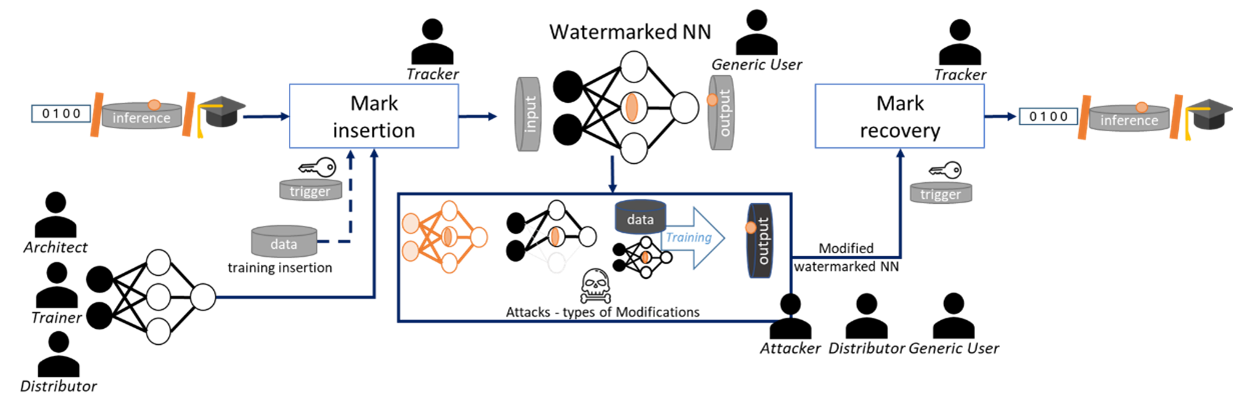

Geneva, Switzerland – 18th February 2026. MPAI – Moving Picture, Audio and Data Coding by Artificial Intelligence – the international, non-profit, unaffiliated organisation developing AI-based data coding standards – has concluded its 65th General Assembly (MPAI-65) publishing the Neural Network Watermarking – Technologies (NNW-TEC) V1.0 standard with a request for Community Comments.
Technical Specification: Neural Network Watermarking – Technologies (NNW-TEC) V1.0 assesses specific NN Traceability technologies with respect to Imperceptibility, Robustness, and Computational Cost using the methodologies specified by the previously approved Neural Network Watermarking – Traceability (NNW-NNT) V1.1 standard. NNW-TEC offers the industry a path to obtain results of Imperceptibility, Robustness, and Computational Cost evaluations for specific Neural Network Traceability Technologies based on standard evaluation methods.
There are several ways to know more about the standards:
- Register to attend the public online presentation of the standard on 10 March 2026 at 15 UTC.
- Read the Neural Network Watermarking – Technologies (NNW-TEC) V1.0 draft standard.
- Read a short Introduction to NNW-TEC V1.0.
Comments of NNW-TEC V1.0 shall reach the secretariat by 13 April 2026.
MPAI-65 has also decided to publish the Company Performance Prediction (CUI-CPP) V2.0 standard in final form.
MPAI is continuing the development of its work plan that involves the following activities:
- AI Framework (MPAI-AIF): developing a Call for Technologies to extend the MPAI-AIF standard to enable a Remote Client Application to access a remote MPAI-AIF Controller, download and execute an AI Workflow, and access the result of the AIW processing.
- AI for Health (AIH-HSP): revising developing the specification of a system receiving and processing licenses AI Health Data and enabling clients to improve health processing models via federated learning.
- Context-based Audio Enhancement (CAE-USC): developing the Audio Six Degrees of Freedom (CAE-6DF) and the Audio Object Rendering (CAE-AOR) standards.
- Connected Autonomous Vehicle (CAV-TEC): developing a new version of the flagship specification CAV-TEC with security support.
- Compression and Understanding of Industrial Data (CUI-CPP): developing a reference software implementation of CUI-CPP V2.0.
- End-to-End Video Coding (MPAI-EEV): exploring the potential of AI-based End-to-End Video coding in compressing video sequences.
- AI-Enhanced Video Coding (MPAI-EVC): exploring new standards that benefit from the use of Super Resolution filters.
- Governance of the MPAI Ecosystem (MPAI-GME): operating the MPAI Ecosystem per the MPAI-GME Specification.
- Human and Machine Communication (MPAI-HMC): exploring the use of AI in human-to-machine and machine-to-machine communication.
- Multimodal Conversation (MPAI-MMC): developing specifications of new data types especially in the context of the PGM-AUA standard.
- MPAI Metaverse Model (MMM-TEC): developing V2.2 of MMM-TEC with capabilities enabling virtual metaverse economies.
- Neural Network Watermarking (NNW-TEC): Refining the new Neural Network Watermarking (MPAI-NNW) – Technologies (NNW-TEC) standard published for Community Comments.
- Object and Scene Description (MPAI-OSD): developing specifications of new data types especially in the context of the PGM-AUA standard.
- Portable Avatar Format (MPAI-PAF): discussing the impact of MPAI standards planned or under development on MPAI-PAF V1.5.
- AI Module Profiles (MPAI-PRF): extending the scope of the current version of AI Module Profiles.
- Server-based Predictive Multiplayer Gaming (MPAI-SPG): exploring new standard opportunities in the domain.
- Data Types, Formats, and Attributes (MPAI-TFA) extending the standard to data types used by MPAI standards that are planned or under development.
- XR Venues (XRV-LTP): developing the standard for improved execution of Live Theatrical Performances using AI.
Legal entities and representatives of academic departments supporting the MPAI mission and able to contribute to the development of standards for the efficient use of data can become MPAI members. New members joining before 31st December 2025 have their membership extended until 31st December 2026.
Please visit the MPAI website, contact the MPAI Secretariat for specific information, subscribe to the MPAI Newsletter and follow MPAI on social media: LinkedIn, Twitter, Facebook, Instagram, and YouTube.