
<-Threat Model Go to ToC Trust Establishment Protocol ->
1 Definition
The Verification Pipeline defines the ordered set of operations performed by a Trust Anchor to determine whether a Process Instance (PI) can be trusted within the MPAI‑PTF Trust Framework.
Based on the trust‑related data types defined in PTF (CII, credentials, evidence, policies, trust messages) it produces a Trust Response indicating whether the received messaged should be trusted.
The pipeline is deterministic, policy‑driven, and produces verifiable Trust Operations for auditability.
2 Objectives
The Verification Pipeline shall:
- Ascertain the trustability of the Requester by which the trust response has been solicited. This involved use of information that has been exchanged by the two parties “out of band”.
- Ensure the validity of the network identity of the Process Instance from which the message has been received.
- Validate the authentication credentials associated with the Process Instance from which the message has been received.
- Validate attestation evidence supporting the Process Instance’s claim of authorisation pertinence.
- Evaluate the evidence and policies governing trust decisions relating to the Requester.
- Produce a Trust Response indicating success or failure.
- Record Trust Operations for audit and traceability.
3 Inputs
The pipeline takes into consideration the following types of information:
- Cryptographic Instance Identity (CII)
- InstanceCredential
- ProcessLifecycleCredential
- AttestationEvidence
- PolicyBinding
- VerificationProfile (from Profile)
- TrustRequest (from Trust Message)
- Network Locality
4 Outputs
The pipeline produces:
- TrustResponse message
- TrustOperation records
- Optional logs for audit and compliance
5 Functional Requirements
The Verification Pipeline shall:
- Ingest the Trust Request
- Identify the requester.
- Validate the provenance and temporality of the trust message.
- Identify the requested trust operation.
- Load the applicable VerificationProfile.
- Verify the Cryptographic Instance Identity (CII)
- Validate structure and required fields.
- Verify signature using SAT algorithms.
- Check key validity and role consistency.
- Verify Credentials
- Validate InstanceCredential.
- Validate ProcessLifecycleCredential.
- Check validity intervals.
- Verify issuer signatures.
- Check credential chains if applicable.
- Verify Attestation Evidence
- Validate evidence type (SET).
- Verify hashes and signatures (SAT).
- Check freshness requirements.
- Check evidence completeness.
- Evaluate Policies
- Load PolicyBinding.
- Evaluate policy rules defined in the VerificationProfile.
- Check constraints, required attributes, and trust anchors.
- Aggregate Results
- Combine identity, credential, evidence, and policy outcomes.
- Apply VerificationProfile decision logic.
- Produce Trust Response
- Status: Success or Failure.
- Optional failure reason.
- Optional result payload.
- Record Trust Operations
- Log each verification step as a TrustOperation.
- Sign the Trust Response.
6 Processing Steps
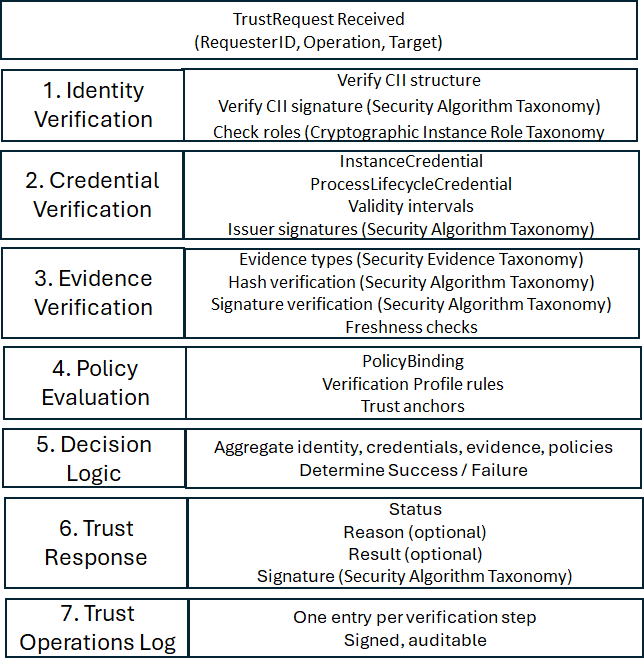
The pipeline executes the following ordered steps:
Each step may produce intermediate Trust Operations for auditability. |
 |
7 Error Handling
The pipeline shall:
- Fail fast on malformed or unverifiable objects.
- Provide a clear failure reason in the Trust Response.
- Log all failures as TrustOperations.
- Never partially establish trust.
8 Security Considerations
The pipeline shall:
- Verify provenance
- Use SAT algorithms for all cryptographic verification.
- Reject weak or deprecated algorithms.
- Validate timestamps and freshness.
- Ensure policy evaluation cannot be bypassed.
- Protect TrustOperations and TrustResponses with signatures.
9 Conformance
A conforming Verifier shall:
- Implement all mandatory steps in the Verification Pipeline.
- Support all required PTF data types.
- Use SAT and SET taxonomies.
- Produce TrustOperations for each verification step.
- Produce a signed TrustResponse.
10 Cross Reference Table
Data Types Used in Each Verification Step
| Verification Step | Data Types Used | Purpose |
|---|---|---|
| Request Intake | TrustRequest, VerificationProfile | Identify operation, target, and applicable rules |
| Identity Verification | CryptographicInstanceIdentity (CII), SecurityAlgorithmTaxonomy | Verify identity, roles, and signatures |
| Credential Verification | InstanceCredential, ProcessLifecycleCredential, SecurityAlgorithmTaxonomy | Validate credentials, issuers, validity intervals |
| Evidence Verification | AttestationEvidence, SecurityEvidenceTaxonomy, SecurityAlgorithmTaxonomy | Verify evidence type, hash, signature, freshness |
| Policy Evaluation | PolicyBinding, VerificationProfile, TrustAnchor, CryptographicInstanceRoleTaxonomy | Evaluate trust rules and constraints |
| Decision Logic | All above | Aggregate results and determine trust outcome |
| Trust Response | TrustResponse, SecurityAlgorithmTaxonomy | Produce signed trust decision |
| Trust Operations Log | TrustOperation, TrustOperationTaxonomy | Record each verification step for auditability |