<-Data Types Go to ToC Verification Pipeline ->
1 Threat Model
The PTF Trust Framework assumes a Full‑Trust environment in which no Process Instance (PI), no credential, and no communication channel is trusted by default.
The threat model includes:
1.1 Identity Threats
- Impersonation of a Process Instance
- Use of forged or stolen cryptographic keys
- Replay of previously valid identities or credentials
1.2 Credential Threats
- Forged InstanceCredentials or ProcessLifecycleCredentials
- Tampering with credential contents
- Use of expired or revoked credentials
1.3 Evidence Threats
- Injection of fabricated attestation evidence
- Replay of stale evidence
- Manipulation of evidence hashes or signatures
1.4 Policy Threats
- Bypassing policy evaluation
- Using incorrect or outdated policies
- Manipulating PolicyBinding objects
1.5 Communication Threats
- Man‑in‑the‑middle attacks
- Message tampering
- Replay of TrustRequests or TrustResponses
1.6 Data Exchange Threats
- Unauthorized access to exchanged data
- Violation of legal or security constraints
- Loss of provenance or annotation integrity
2 Security Objectives
PTF aims to ensure:
2.1 Authenticity
All identities, credentials, evidence, and messages must be verifiably authentic using SAT algorithms.
2.2 Integrity
All PTF objects must be protected against tampering through signatures and hashes.
2.3 Freshness
Evidence and credentials must be validated against timestamps and validity intervals.
2.4 Authorization
Only authorized PIs and AIMs may access or process data, as defined in DEM.
2.5 Non‑repudiation
TrustOperations and TrustResponses must be signed to provide auditability.
2.6 Least Privilege
VerificationProfiles and PolicyBindings ensure PIs only receive the trust level required for their function.
3 Security Considerations
3.1 Cryptographic Algorithms
All cryptographic operations must use algorithms defined in the Security Algorithm Taxonomy (SAT).
Deprecated or weak algorithms must be rejected.
3.2 Trust Anchors
Trust anchors must be validated using the TrustAnchor data type and must be securely distributed.
3.3 Credential Chains
If credential chains are used, each link must be validated for:
- signature
- issuer
- validity interval
- role consistency
3.4 Evidence Freshness
AttestationEvidence must include timestamps or freshness indicators and random unpredictable elements. Replay attacks must be mitigated by rejecting stale evidence.
3.5 Policy Enforcement
Policies must be:
- authenticated
- bound to the correct target
- evaluated deterministically
Policy bypass must not be possible.
3.6 Message Security
TrustMessage objects must be:
- signed
- timestamped
- non‑replayable
3.7 Data Exchange Metadata (DEM)
After trust is established, DEM ensures:
- authorized access
- legal compliance
- security constraints
- provenance
- annotation integrity
3.8 Logging and Auditability
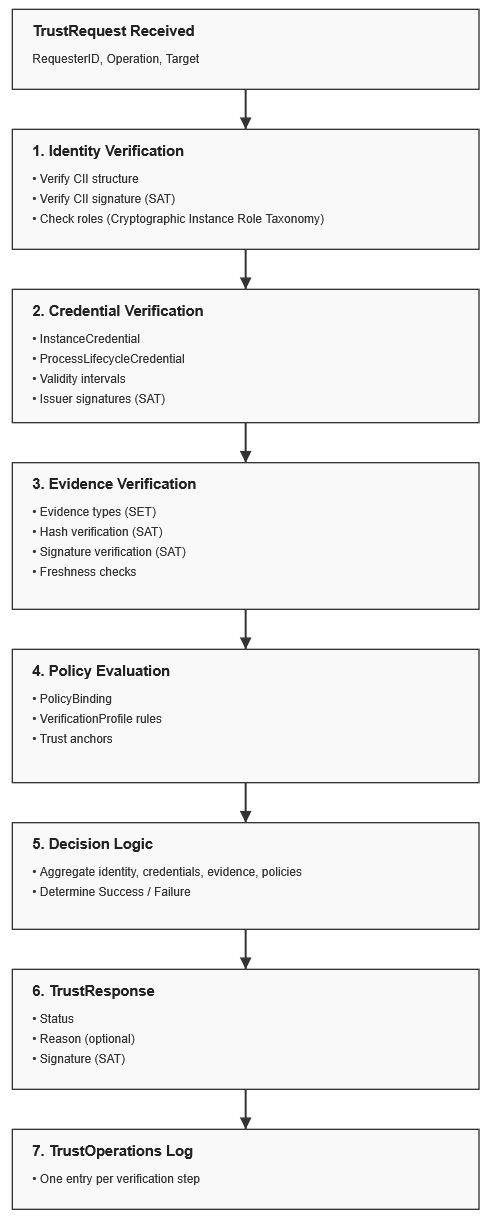
Each verification step must produce a TrustOperation entry.
Logs must be protected against tampering.
4 Assumptions and Limitations
PTF assumes:
- Cryptographic keys are generated and stored securely by PIs.
- Time sources used for validity and freshness checks are to be synchronised and trustworthy.
- Underlying transport channels may be untrusted, but signatures protect integrity.
- PTF does not define runtime sandboxing or execution isolation for PIs.
- PTF does not define key management protocols (only key usage and identity binding).
5 Security Properties Table
| PTF Object | Security Protections | Threats Mitigated |
|---|---|---|
| Cryptographic Instance Identity | SAT signature, key binding, role taxonomy | Impersonation, key misuse, identity spoofing |
| InstanceCredential | SAT signature, issuer validation, validity interval | Forged credentials, tampering, expired credentials |
| ProcessLifecycleCredential | SAT signature, lifecycle state binding | Fake lifecycle states, replay of old states |
| AttestationEvidence | SET type validation, hash verification, signature verification, freshness | Fake evidence, replay attacks, tampering |
| PolicyBinding | Signature, binding to target, profile‑driven rules | Policy bypass, incorrect policy use |
| VerificationProfile | Deterministic rule evaluation | Inconsistent trust decisions, privilege escalation |
| TrustMessage (Request/Response) | Security Algorithm Taxonomy signature, timestamps, temporal unicity | MITM, tampering, replay of requests/responses |
| TrustOperation | Signed audit log entries | Non‑repudiation, audit tampering |
| TrustAnchor | Root‑of‑trust validation | Fake issuers, rogue CAs |
| DataExchangeMetadata (DEM) | Traceability, authorisations, legality, security metadata, provenance | Unauthorised access, legal violations, data misuse |
6 Threats → Mitigations → PTF Data Types → Pipeline Steps
| Threat | Mitigation Mechanism | PTF Data Types Involved | Verification Pipeline Step |
|---|---|---|---|
| Identity Impersonation | Out-of-band authentication, signature verification, key binding, role validation | CII, SAT, CryptographicInstanceRoleTaxonomy | Identity Verification |
| Use of forged or stolen keys | Signature verification, trust anchor validation | CII, TrustAnchor, SAT | Identity Verification |
| Replay of old identities | Temporal unicity, timestamp checks, validity intervals | CII, InstanceCredential | Identity Verification |
| Forged credentials | Signature verification, issuer validation | InstanceCredential, PLC, SAT | Credential Verification |
| Tampered credentials | Hash/signature verification | InstanceCredential, PLC, SAT | Credential Verification |
| Expired or revoked credentials | Validity interval checks | InstanceCredential, PLC | Credential Verification |
| Fake evidence | Evidence type validation (SET), signature verification | AttestationEvidence, SET, SAT | Evidence Verification |
| Tampered evidence | Hash verification, signature verification | AttestationEvidence, SAT | Evidence Verification |
| Replay of stale evidence | Freshness checks (timestamps, nonces) | AttestationEvidence | Evidence Verification |
| Incomplete evidence | Completeness checks | AttestationEvidence, VerificationProfile | Evidence Verification |
| Policy bypass | PolicyBinding authentication, profile enforcement | PolicyBinding, VerificationProfile | Policy Evaluation |
| Use of wrong or outdated policies | Signature verification, version checks | PolicyBinding | Policy Evaluation |
| Privilege escalation | Deterministic rule evaluation | VerificationProfile | Policy Evaluation |
| Message tampering | Signed TrustMessages | TrustMessage, SAT | Request Intake / Response Generation |
| Replay of TrustRequests/Responses | Timestamps, nonces | TrustMessage | Request Intake |
| Man‑in‑the‑middle attacks | Sender network address obfuscation, end‑to‑end signatures | TrustMessage, SAT | Request Intake / Response Generation |
| Audit tampering | Signed TrustOperations, Data Exchange Metadata | TrustOperation, SAT | Operation Logging |
| Unauthorized data access (post‑trust acquisition) | DEM authorisations | DataExchangeMetadata | Post‑Trust Data Exchange |
| Violation of security | DEM security metadata | DataExchangeMetadata | Post‑Trust Data Exchange |
7 Verification Pipeline