
| Architecture | Operation | The Actors in the Scenario | Sequence Diagram | Life cycle |
1 Architecture
MPAI as a Service specifies a remote HTTPS-based protocol that exposes the MPAI AIF Basic API functionality for use by a Remote Client (a remote HTTPS 1.1 Client). The following API specification describes the minimum profile of Request and Response Messages.
Figure 1 depicts the global architecture of an System enabling MPAI as a Service (MaaS) allowing Remote Client Application (RCA) to select and run AI Mo instances.
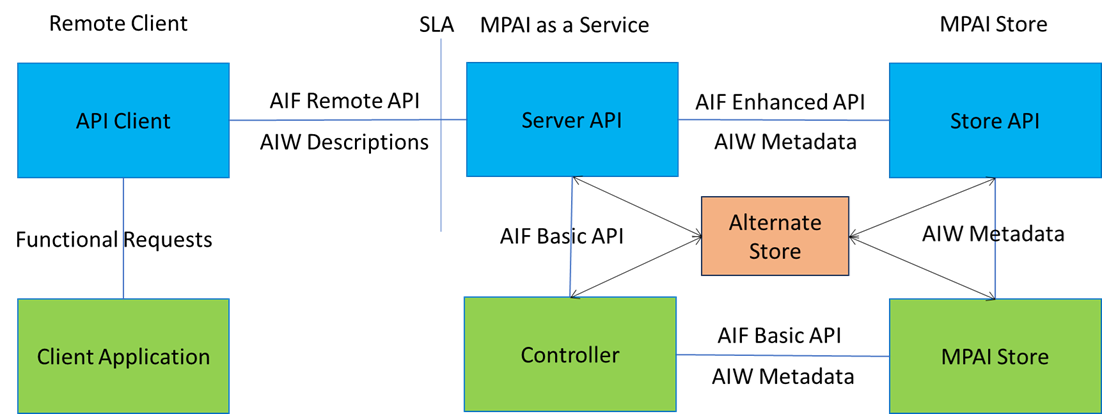
Figure 1 – Reference architecture of MaaS
The RCA issues HTTPS Requests to the Server API through the local API Client. These Requests comprise AIF Controller instance management and AIM instance management and AIM Port message exchange as required to satisfy the MPAI as a Service needs of the RCA.
The Server API, in response to the received Requests, negotiates through the Store API the selection of appropriate AIM Descriptions and with the SCI performs subsequent AIM instance management using the AIF API (Start/Pause/Resume/Stop). SCI retrieves Descriptions and Components of AIMs from the MPAI Store for instantiation as requested by the Server using the AIF API.
2 Operation
2.1 Creation of infrastructure
Creation of infrastructure is the responsibility of the deployment/control plane to avoid access to the application data plane by the control plane and vice-versa.
2.1.1 Creation of an AIF Controller instance
RCA requests creation of one or more SCIs receiving in return SCI identities for use in subsequent API requests to identify the SCI to which the message is directed.
2.1.2 Launch of the desired AI Modules
RCA submits a request to the SCI(s) for the launch of the desired AIM(s).
The objective of AIM launch is the acquisition of an AIM identity for use in subsequent API requests to identify the AIM with which input/output messages may be exchanged.
2.2 Message Exchange
Application data exchange is the responsibility of the application data plane thus ensuring non-exposure of application data to the control plane.
2.2.1 Delivery of messages to the input ports of the AI Module
RCA submits requests to the SCI for the delivery of AIF application data messages to the desired input Port(s) of the launched AIM(s).
2.2.2 Reception of messages from the output ports of the AI Module
RCA may submit requests to the SCI for the reception of AIF Messages from the desired output Port(s) of the launched AIM(s). The RCA may make provision for asynchronous delivery of the response when required.
2.3 Termination of infrastructure
2.3.1 Termination of the AI Module
RCA submits requests to the SCI for the termination of the launched AIM(s).
2.3.2 Release of the AIF Controller
RCA requests termination of the SCI(s).
3. The Actors in the Scenario
A – MPAI Store Service
Provides a package validation, registration and verification service for MAI AIM Bundles, Metadata and Packages
A – MPAI Store Service
Provides a package validation, registration and verification service for MAI AIM Bundles, Metadata and Packages
C – MAS API Service
Exposes a REST API allowing Remote Client Applications to use AI Modules ‘As a Service’
D – Remote Client Application
A Remote Client Application desires to launch and use known MPAI AIMs for data processing and result retrieval.
E – Controller Instance
Is created by the MAS API Service for the management of AIM’s launched for a Remote Client application.
F – Deployment Controller
Is responsible for the provisioning and life cycle management of resources required for the running of Controllers and AIMs.
G – Deployed Resources
The deployed VM and / or Containerised resources required for the running of AIMs.
The Actions in the Scenario
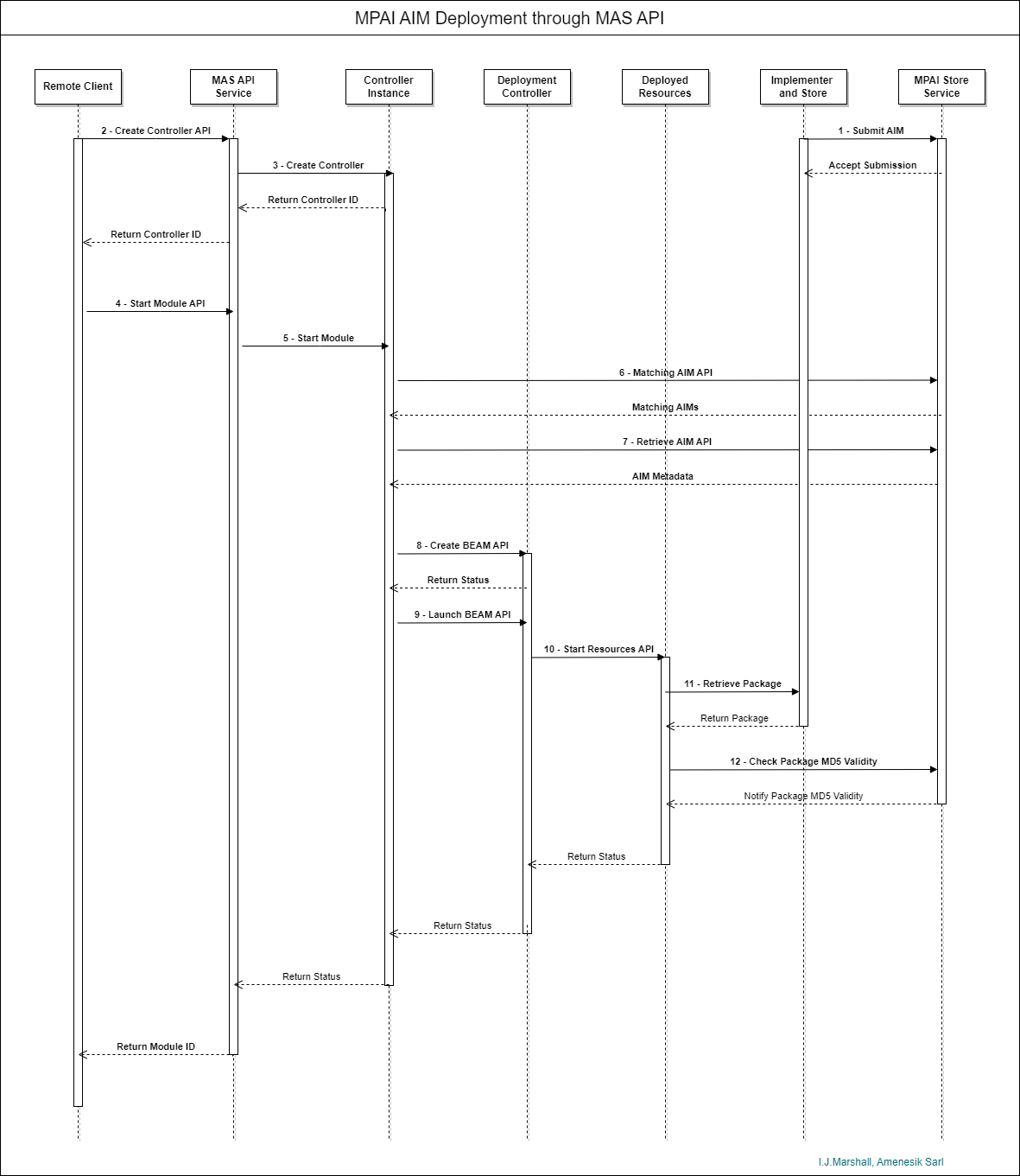
1 – Implementer submits an AIM bundle (metadata, packages) for conformance validation and subsequent publication
2 – Remote Client application issues a Create Controller request to the MAS API Service.
3 – MAS API Service creates the new Controller Instance and notifies the Remote Client Application of its ID .
4 – Remote Client application issues a Start Module request for a suitably identified AIM to the MAS API Service.
5 – MAS API Service forwards the Start Module request to the identified Controller.
6 – The Controller requests the list of matching AIMs from the MPAI Store .
7 – The Controller retrieves the selected AIM Metadata from the MPAI Store .
8 – The Controller creates description and management structures for the resources required for the AIM launch.
9 – The Controller initiates provisioning and Life Cycle management of the resources required for the AIM.
10 – The Deployment Service provisions the resources for the AIM and accompanies installation, configuration and operation.
11 – The installation and configuration procedures of the provisioned resources Retrieve the required Packages from Implementer
12 – The Received Packages are checked for Validity, through MPAI Store, prior to their ultimate activation.
Further Actions
XX – Input Message reception and delivery to be defined.
XX – Output Message reception and delivery to be defined.
XX – AIM Termination will be performed by the Controller Instance when requested by the RCA through the MAS API.
XX – Controller Termination will be performed by the MAS API when requested by the RCA.
4 Sequence diagram
5 Life cycle
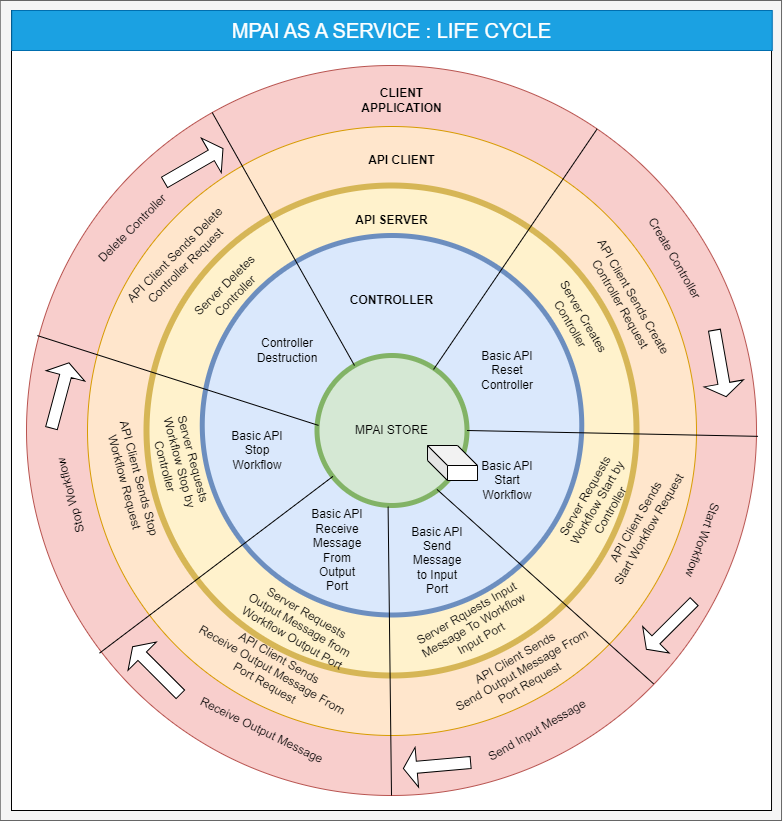
Figure 2 – The life cycle of an MPAI as a Service Instance