

MPAI has a Development Committee in the area of human-machine conversation (MMC-DC). In September 2021, MMC-DC has produced its first standard titled Multimodal Conversation (MPAI-MMC). That standard provides a standard way to represent Emotion with the following syntax:
{
“$schema”:”http://json-schema.org/draft-07/schema”,
“definitions”:{
“emotionType”:{
“type”:”object”,
“properties”:{
“emotionDegree”:{
“enum”: [“High”, “Medium”, “Low”]
},
“emotionName”:{
“type”:”number”
},
“emotionSetName”:{
“type”:”string”
}
}
},
“type”:”object”,
“properties”:{
“primary”:{
“$ref”:”#/definitions/emotionType”
},
“secondary”:{
“$ref”:”#/definitions/emotionType”
}
}
}
The semantics is given by:
| Name | Definition |
| emotionType | Specifies the Emotion that the input carries. |
| emotionDegree | Specifies the Degree of Emotion as one of “Low,” “Medium,” and “High.” |
| emotionName | Specifies the ID of an Emotion listed in Table 2. |
| emotionSetName | Specifies the name of the Emotion set which contains the Emotion. Emotion set of Table 2 is used as a baseline, but other sets are possible. |
Table 1 gives some examples of the MPAI standardised three-level Basic Emotion Set partly based on:
Table 1 – Basic Emotion Set
| EMOTION CATEGORIES | GENERAL ADJECTIVAL | SPECIFIC ADJECTIVAL |
| ANGER | angry | furious irritated frustrated |
| APPROVAL, DISAPPROVAL | admiring/approving disapproving indifferent |
awed contemptuous |
| AROUSAL | aroused/excited/energetic | cheerful playful lethargic sleepy |
| ATTENTION | attentive | expectant/anticipating thoughtful distracted/absent-minded vigilant hopeful/optimistic |
| BELIEF | credulous | sceptical |
| CALMNESS | calm | peaceful/serene resigned |
The semantics of somr elements in Table 1 is provided by Table 2.
Table 2 – Semantics of the Basic Emotion Set
| ID | Emotion | Meaning |
| 1 | admiring/approving | emotion due to perception that others’ actions or results are valuable |
| 2 | amused | positive emotion combined with interest (cognitive) |
| 3 | anger | emotion due to perception of physical or emotional damage or threat |
| 4 | anxious/uneasy | low or medium degree of fear, often continuing rather than instant |
| 5 | aroused/excited/energetic | cognitive state of alertness and energy |
| 6 | arrogant | emotion communicating social dominance |
| 7 | astounded | high degree of surprised |
| 8 | attentive | cognitive state of paying attention |
| 9 | awed | approval combined with incomprehension or fear |
| 10 | bewildered/puzzled | high degree of incomprehension |
| 11 | bored | not interested |
| 12 | calm | relative lack of emotion |
In July MPAI has issued a call for technologies to extend the MPAI-MMC standard. One of the technologies requested is Personal Status defined as “The ensemble of information internal to a person, including Emotion, Cognitive State, and Attitude”. The 3 components are defined
| Attitude | An element of the internal status related to the way a human or avatar intends to position vis-à-vis the Environment or subsets of it, e.g., “Respectful”, “Confrontational”, “Soothing”. |
| Cognitive State | An element of the internal status reflecting the way a human or avatar understands the Environment, such as “Confused”, “Dubious”, “Convinced”. |
| Emotion | An element of the internal status resulting from the interaction of a human or avatar with the Environment or subsets of it, such as “Angry”, “Sad”, “Determined”. |
The Personal Status is conveyed by one or more Modalities, currently, Text, Speech, Face and Gesture.
Respondents to the call are requested to propose the following:
- A Personal Status format capable of describing the evolution of Personal Status over time.
- A Fused Personal Status format supporting the requirements to:
- Include the Emotion, Cognitive Status, and Attitude making up a Personal Status.
- Retain information on the measured values of the different factors in a Personal Status conveyed by the different Modalities.
- Describe the evolution of Personal Status over time.
A Personal Status standard can be used as a standard component in human-machine conversation. One such component is Personal Status Extraction, depicted in Figure 2.
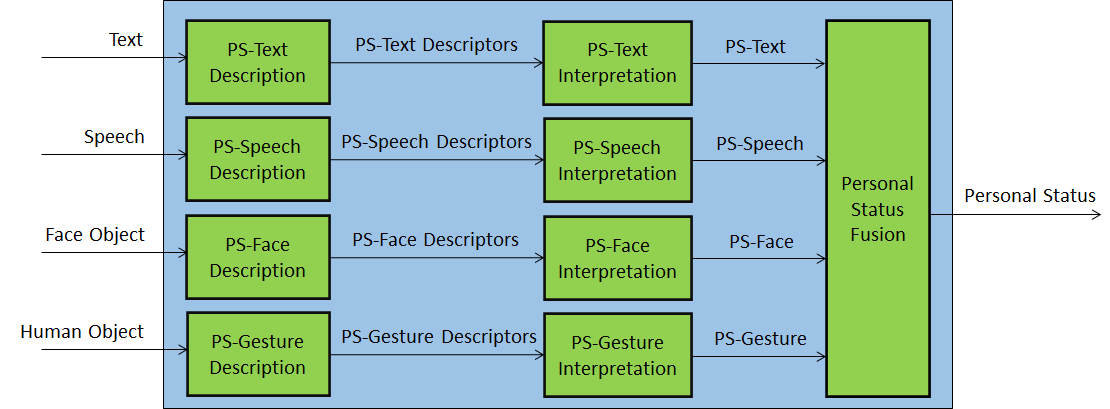
Figure 2 –Personal Status Extraction
Another component is Personal Status Display depicted in Figure 3.
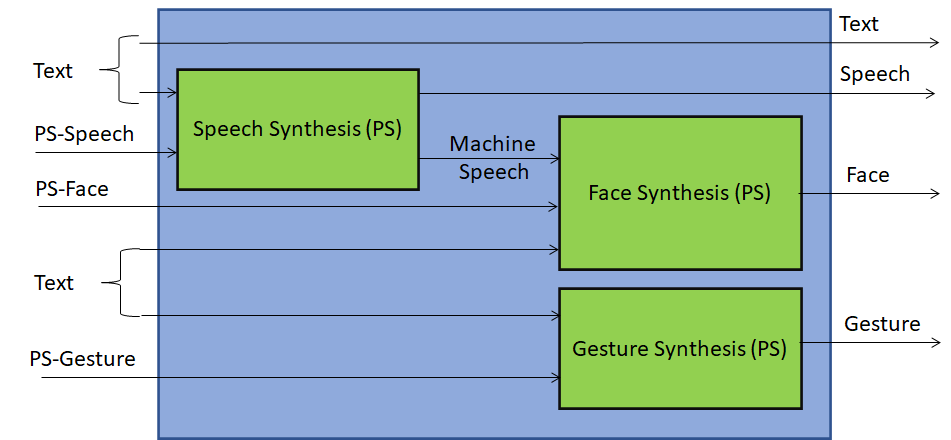
Figure 3 – Personal Status Display