
The Governance of the MPAI Ecosystem standard
A standard on paper does not by itself create a market. The Governance of the MPAI Ecosystem (MPAI-GME) standard specifies what MPAI publishes and who does what with it, so that components built independently by different organisations can be found, trusted and combined.
What MPAI publishes
For each of its standards MPAI develops, approves, publishes and maintains up to four kinds of document, of which the first is always present:
- Technical Specification – what the standard requires.
- Reference Software Specification – working code, so the value of the standard can be judged from something that runs.
- Conformance Testing Specification – the means to establish that an implementation is a correct embodiment of the specification.
- Performance Assessment Specification – methods for measuring how well an implementation does its job.
Currently, MPAI standards include links to Reference Software, and the text of Conformance Testing and Performance Assessment, when one of more of the last three are available.
Who does what in the MPAI Ecosystem
- MPAI is the root of trust. It sets the rules of governance, develops the standards, and appoints Performance Assessors.
- The MPAI Store assigns Implementer IDs, tests submissions for security and conformance, applies labels, and distributes implementations. It is not-for-profit and recovers its costs.
- Implementers build components and submit them to the Store.
- Performance Assessors grade implementations in a domain they are appointed for, and never grade their own.
- Service Providers and End Users run the workflows and report their experiences.
How conformance is established
An implementation is checked for security, then tested for conformance, then optionally assessed for performance — and labelled accordingly. Level 1 means it conforms to the AI Framework. Level 2 adds conformance to an application standard. Level 3 adds an assessed performance grade. A user choosing a component therefore knows what has been verified, and by whom, without taking the implementer’s word for it.
More than conformance
Performance can be assessed against a broad set of dimensions. Beyond quality, an assessment may address robustness under load, extensibility to data outside the stated scope, bias arising from training data, legality in a given jurisdiction such as under the European AI Act, and ethics.
Performance Assessors are appointed by MPAI for a specific domain and performance category; they may be qualified companies or implementers themselves, but will never assess their own work. Their findings are kept confidential unless both parties agree otherwise. What they produce is a grade, together with feedback to the implementer of a nature and minimum extent that the relevant specification sets out.
Benefits
- Implementers reach a market without having to build credibility from scratch.
- Component makers compete on quality within known interfaces.
- Integrators combine components from different sources with confidence they will work together.
- Regulators find an existing chain of accountability from specification through to assessment.
- Users can see what has been tested before they rely on it.
Ultimately, MPAI-GME exists so that independently developed components can be trusted both individually and working together — the conditions for a competitive market in AI components rather than a collection of separated closed systems.
This is the public page of the Governance of the MPAI Ecosystem (MPAI-GME) standard. See the MPAI-GME homepage.
MPAI-GME lays down the operation and the rules of the ecosystem composed of: MPAI, its standards, standards implementers, performance assessors, the MPAI Store and end users.
The MPAI Ecosystem is the society created by the set of MPAI standards. All society need a set of rules to operate and Governance of the MPAI Ecosystem V2.0 is the constitution that will govern the MPAI society for the next few years.
MPAI is the root of trust of the MPAI Ecosystem with the following authority:
- Defines the rules of Governance.
- Develops the 4 components of an MPAI Standard (Technical, Reference Software, Conformance Testing, and Performance Assessment specifications).
- Assigns to a specific company the Ecosystem activities envisaged for the MPAI Store.
- Appoints Performance Assessors.
The MPAI Store has the following roles and duties:
- Acts as the Registration Authority od Implementer IDs.
- Establishes distribution agreements with Implementers.
- Tests the conformance of implementations.
- May receive and publish notifications from Performance Assessors.
- Posts software Implementations for download.
- Manages a reputation system publishing reports of their user experience.
Implementers
- Obtain an Implementer ID from the MPAI Store.
- Make implementations.
- Submit implementations to the MPAI Store.
- May submit Implementations to Performance Assessors.
Performance Assessors
- Are appointed for a particular domain and Performance category.
- Assess the Performance of an Implementation.
The ecosystem is represented by the figure.
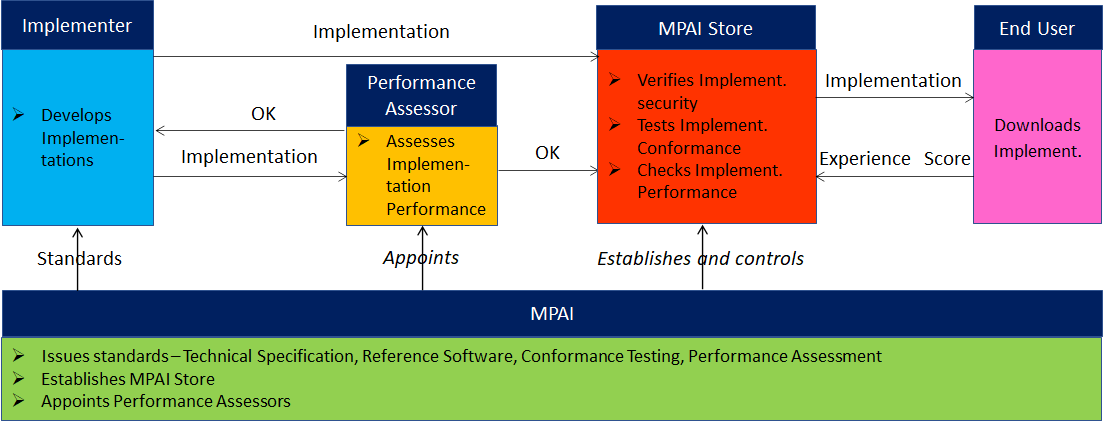
The Governance of the MPAI Ecosystem Technical Specification is publicly available.
If you wish to participate in this work you have the following options
- Join MPAI
- Keep an eye on this page.
Return to the MPAI-GME page