Moving Picture, Audio and Data Coding
by Artificial Intelligence

Archives: 2023-09-15

MPAI publishes the Draft “MPAI as a Service” V1.0 standard and “MPAI Metaverse Model – Technologies” V2.2 as an MPAI standard

Geneva, Switzerland – 8th July 2026. MPAI – Moving Picture, Audio and Data Coding by Artificial Intelligence – the international, non-profit, unaffiliated organisation developing AI-based data coding standards – has concluded its 70th General Assembly (MPAI-70) publishing:

AI Framework (MPAI-AIF) is a foundational MPAI standard that enables the execution of AI processes in a standard environment. Among other updates, MPAI-AIF V3.0 includes APIs enabling a Controller in an MPAI as a Service context to verify that an AI Module that has not been downloaded from the MPAI Store, is the one the Controller intended.

Audio Object Rendering (CAE-AOR) is one of the Context-based Audio Enhancement standards. It enables a user to modify a wide range of properties of Audio Objects in an audio scene and render the resulting Audio Object to experience the immersive space from different perspectives through headphones or loudspeakers.

MPAI as a Service (MPAI-MAS) enables a client application to request execution of an AI Module by a Controller running on a remote MPAI AI Framework instance. MPAI-MAS enables cloud service providers to offer to their customers online execution services of AI applications.

MPAI Metaverse Model – Technologies (MMM-TEC) V2.2 is one of the MPAI flagship standards that integrates a variety of technologies developed by various MPAI organisational units. Leveraging its basic security technologies – such as unique Identifiers, Rights, and Rules – and the new technologies added on this occasion, MMM-TEC V2.2 enables the development of versatile market economies.

MPAI-70 also announced that on 15 July at 14 UTC a Seminar on “A future for Video Coding – The MPAI End-to-End Video Coding (EEV) Project” will be held online. The goal is two-fold: to review what has been learned from the last years of investigation that led the EEV-0.6 reference model to outperform the VVC standard and to explore promising avenues of development for the coming EEV-0.7 reference model. Register here to attend.

MPAI is continuing the development of its work plan that involves the following activities:

  1. AI Framework (MPAI-AIF): developing a Call for Technologies to extend the MPAI-AIF standard to enable a Remote Client Application to access a remote MPAI-AIF Controller, download and execute an AI Workflow, and access the result of the AIW processing.
  2. AI for Health (AIH-HSP): reviewing areas relevant for AI for Health and preparing for the development of Reference Software.
  3. Context-based Audio Enhancement (CAE-USC): developing the Audio Six Degrees of Freedom (CAE-6DF) and the Audio Object Rendering (CAE-AOR) standards.
  4. Connected Autonomous Vehicle (CAV-TEC): preparing for the development of Reference Software.
  5. Compression and Understanding of Industrial Data (CUI-CPP): developing a reference software implementation of CUI-CPP V2.0.
  6. End-to-End Video Coding (MPAI-EEV): exploring the potential of AI-based End-to-End Video coding in compressing video sequences.
  7. AI-Enhanced Video Coding (MPAI-EVC): exploring the possibility of a new standard for optimised down- and up-sampling filters..
  8. Governance of the MPAI Ecosystem (MPAI-GME): operating the MPAI Ecosystem per the MPAI-GME Specification.
  9. Human and Machine Communication (MPAI-HMC): exploring the use of AI in human-to-machine and machine-to-machine communication.
  10. Multimodal Conversation (MPAI-MMC): developing specifications of new data types especially in the context of the PGM-AUA standard.
  11. MPAI Metaverse Model (MMM-TEC): developing V2.2 of MMM-TEC with capabilities enabling virtual metaverse economies.
  12. Neural Network Watermarking (NNW-TEC): Reviewing new Neural Network Watermarking areas.
  13. Object and Scene Description (MPAI-OSD): developing specifications of new data types especially in the context of the PGM-AUA standard.
  14. Portable Avatar Format (MPAI-PAF): discussing the impact of MPAI standards planned or under development on MPAI-PAF V1.5.
  15. AI Module Profiles (MPAI-PRF): extending the scope of the current version of AI Module Profiles.
  16. Server-based Predictive Multiplayer Gaming (MPAI-SPG): exploring new standard opportunities in the domain.
  17. Data Types, Formats, and Attributes (MPAI-TFA) extending the standard to data types used by planned or under development MPAI standards.
  18. XR Venues (XRV-LTP): developing the standard for improved execution of Live Theatrical Performances using AI.

Legal entities and representatives of academic departments supporting the MPAI mission and able to contribute to the development of standards for the efficient use of data can become MPAI members.

Please visit the MPAI website, contact the MPAI Secretariat for specific information, subscribe to the MPAI Newsletter and follow MPAI on social media: LinkedIn, Twitter, Facebook, Instagram, and YouTube.


An overview of the Connected Autonomous Vehicle – Technologies standard

1      Introduction

The CAV-TEC standard assumes that a land-based Connected Autonomous Vehicle (CAV) is composed of the following elements:

  1. Connected Autonomous Operation (CAO), a CAV component that:
    1. Receives a request from an authorised human or process to start from a specified Position and Orientation (called Point of View) and reach a specified destination point of view.
    2. Uses onboard sensors to capture data from the environment, which is populated by humans carrying devices, other CAVs, and objects such as vehicles, roadside units, and traffic lights. These entities may be “CAV-aware”, i.e., capable of transmitting information understood by the CAV.
    3. Exchanges relevant data with peer CAOs onboard other CAVs within range.
    4. Issues control instructions.
    5. Complies with applicable traffic laws, properly represented in digital form.
  2. Three subsystems:
    1. Motors, to increase and decrease the vehicle’s speed.
    2. Steering wheels, to change the vehicle’s direction of motion.
    3. Brakes, to substantially reduce the speed of the vehicle.
  3. The rest of the vehicle.

A Connected Autonomous Operation instance is implemented as an AI Module executed in an AI Framework instance, according to the AI Framework (MPAI-AIF) standard. After trust has been established as specified by the Process Instance Trust Framework (MPAI-PTF) standard, the AI Modules can interact by exchanging data enriched with Data Exchange Metadata.

Figure 1 depicts the interaction of CAV subsystems with infrastructure, other vehicles, and the environment.
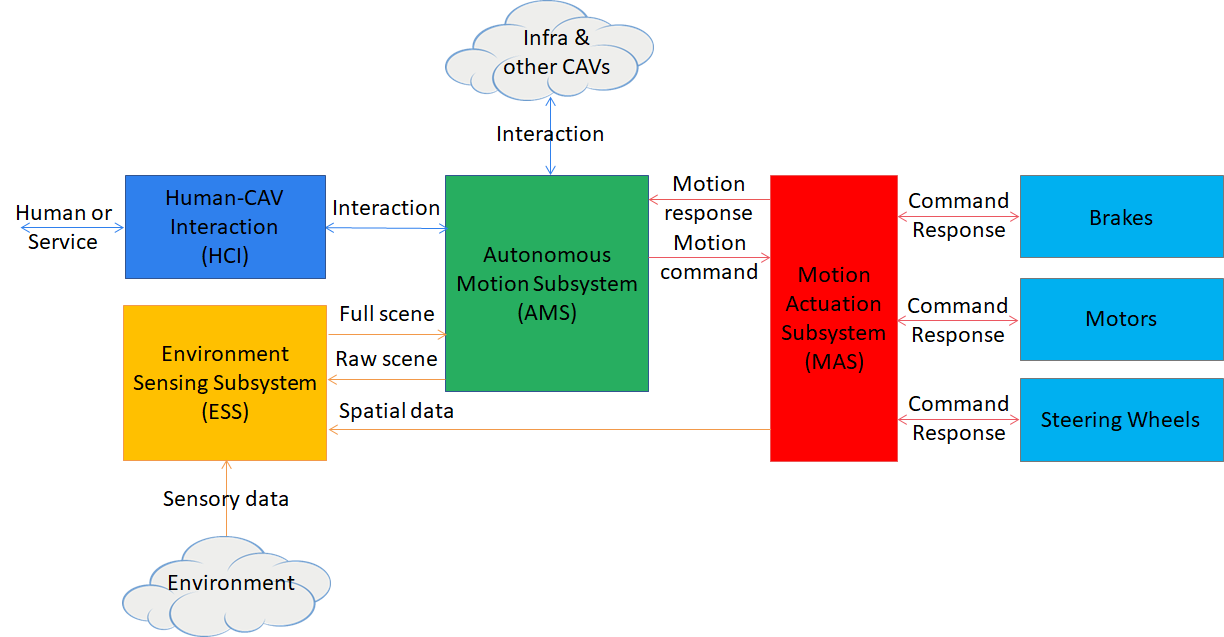
Figure 1 – CAV subsystems, infrastructure/CAVs, and environment

The basic steps of a CAO workflow are:

  • A human or service interacts with the Human–CAV Interaction (HCI) subsystem to activate and communicate with the Autonomous Motion Subsystem (AMS).
  • The AMS acts as the central intelligence, coordinating perception, decision-making, and control, and activating the Environment Sensing Subsystem (ESS).
  • The ESS acquires sensory data from the environment, receives spatial information from the AMS, consolidates it, and provides a raw scene description to the AMS.
  • The AMS exchanges information with infrastructure and other CAVs, and generates motion commands directed to the Motion Actuation Subsystem (MAS).
  • The MAS performs low-level control and manages execution through actuators such as brakes, motors, and steering, which affect the environment and return status information to the MAS and upstream subsystems.

The Motion Actuation Subsystem (MAS) issues commands to and receives responses from brakes, motors, and steering wheels. These components operate as processes rather than AI Modules (AIMs).

Figure 2 depicts the four Subsystems composing a CAO. Each Subsystem is implemented as a Composite AIM conforming with Technical Specification AI Framework (MPAI-AIF) V3.0 and Process Instance Trust Framework (MPAI-PTF) V1.0.
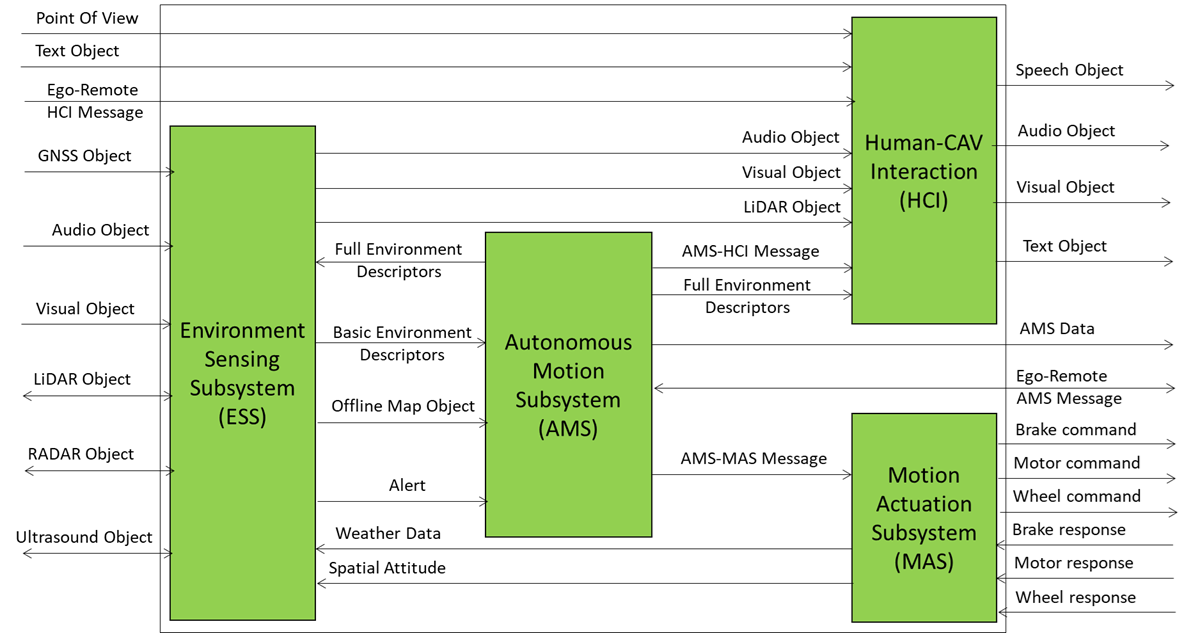
The Reference Model of a CAV

Figure 2 – The Reference Model of a CAV

AI Modules (AIMs) may be located in different subsystems, provided that the interfaces specified by CAV-TEC are preserved.

A human approaching a CAV can request, via the Human-CAV Interaction Subsystem (HCI), to be taken to a specified Point of View using a combination of audio, visual, and LiDAR signals. A remote process can issue a similar request to the CAV.

In both cases, the request is passed to the Autonomous Motion Subsystem (AMS), which queries the Environment Sensing Subsystem (ESS) to obtain the current Point of View of the CAV. Using this information from the ESS, together with the destination Point of View and access to offline maps, the AMS can propose one or more routes, from which the human or process can select.

With the human aboard, the AMS continuously receives environmental information from the ESS – possibly complemented by data received from other CAVs within range – and instructs the Motion Actuation Subsystem to move the vehicle accordingly.

2          Human-CAV Interaction

The Human–CAV Interaction Subsystem (HCI) has been designed to enable the following operations:

  1. Use visual and speech information to recognise a human addressing the CAV as a legitimate user of the vehicle.
  2. Recognise the request made by the human to be taken to a specific Point of View and establish a dialogue with the Autonomous Motion Subsystem (AMS) to respond to and actuate the request.
  3. Recognise the identities of multiple humans, if present.
  4. Recognise objects indicated by humans.
  5. Conduct a dialogue with human passengers, including the ability to understand their emotional state and to present itself as an avatar with a congruent emotional expression.
  6. Respond to human requests to see or hear what the AMS perceives outside the CAV by requesting and rendering the information received from the AMS.

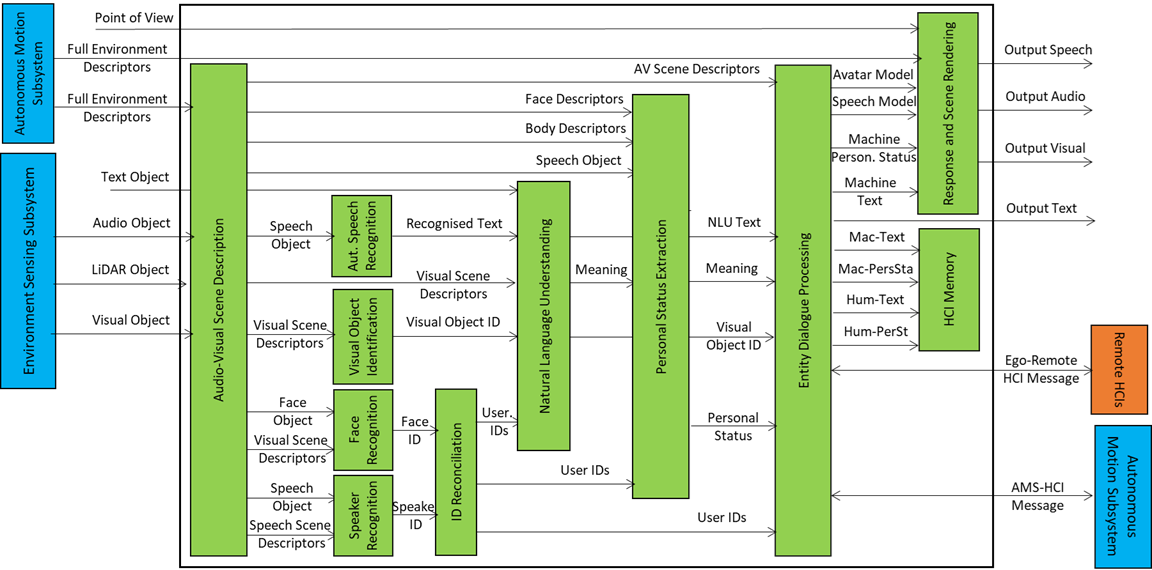
Figure 3 depicts all the connected components (AI Modules) required to satisfy the design objectives.
Reference Model of CAV-HCI

Figure 3 – Reference Model of CAV-HCI

The Audio-Visual Scene Description (AVS) monitors the environment and produces Audio–Visual Scene Descriptors. It extracts Speech Scene Descriptors from the scene and, from these, derives Speech Objects corresponding to any speaking human. Visual Scene Descriptors may also be extracted in the form of face and body descriptors of all humans involved.

The CAV activates Automatic Speech Recognition (ASR) to recognise the speech of each human and convert it into text. Natural Language Understanding (NLU) processes this text and extracts the meaning of each input speech.

Speaker Identity Recognition (SIR) and Face Identity Recognition (FIR) enable the CAV to reliably determine the identities of the humans with whom the HCI interacts. If the face identifiers provided by FIR correspond to those provided by SIR, the CAV may proceed to handle further requests.

The CAV interacts with humans through Entity Dialogue Processing (EDP). When a human requests to be taken to a destination, the EDP interprets the request and communicates it to the Autonomous Motion Subsystem (AMS). A dialogue may then ensue, in which the AMS offers alternative options to satisfy user preferences (e.g., a longer but more comfortable route or a shorter but less predictable one).

While the CAV moves towards the destination, the HCI may converse with the passengers, present the Full Environment Descriptors generated by the AMS, and provide information about the CAV from the Ego AMS or, more generally, from the HCIs of remote CAVs.

3      Environment Sensing Subsystem

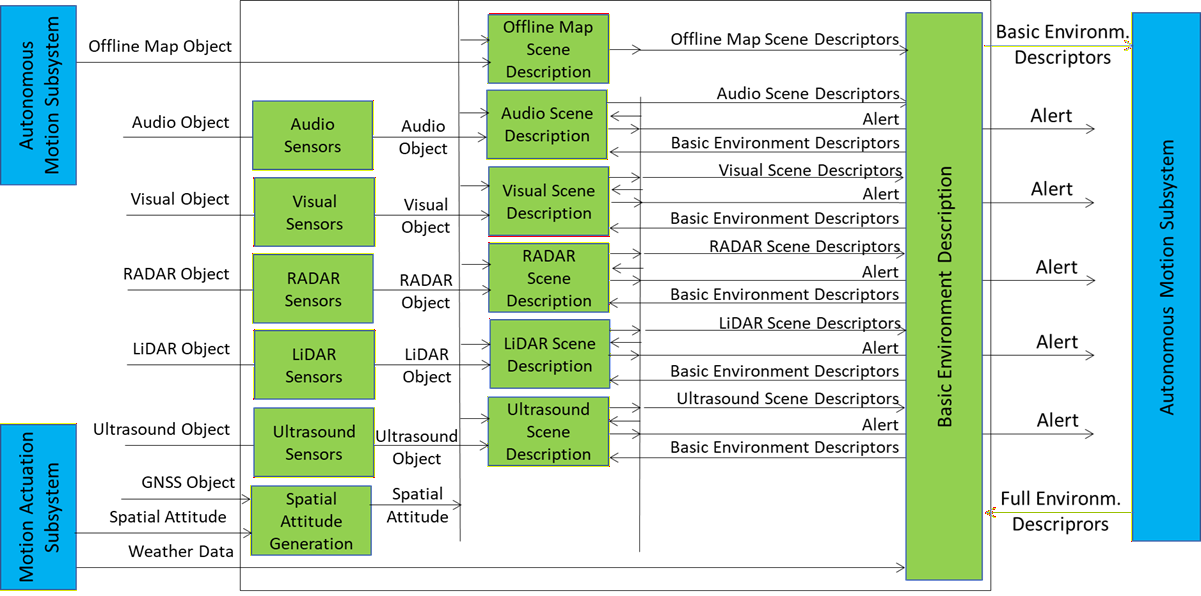
The Environment Sensing Subsystem (ESS) receives data captured by a variety of Environment Sensing Technologies (EST). CAV-TEC assumes that these sensors may operate in the visual or audio range, at microwave frequencies (RADAR), and at near-infrared frequencies. Ultrasound sensors may also be used. Digital maps—called offline maps—can be accessed as well, although they may not represent the current state of the environment. Figure 4 depicts the sensors listed above.
Reference Model of CAV-ESS

Figure 4 – Reference Model of CAV-ESS

When the CAV is activated in response to a request from a human or a process, Spatial Attitude Generation continuously computes the CAV’s spatial attitude based on the initial Point of View provided by the Motion Actuation Subsystem and on information from Global Navigation Satellite Systems (GNSS), if available.

An EST-specific Scene Description AI Module produces EST-specific Scene Descriptors, which are integrated into the Basic Environment Descriptors (BED) by the Basic Environment Description AI Module. This integration uses all available sensing technologies, weather data, road state information, and Full Environment Descriptors from previous instants.

Although Figure 5 represents each sensing technology as being processed by an individual Environment Sensing Technology (EST), an implementation may combine two or more Scene Description AI Modules to handle multiple ESTs, provided that the relevant interfaces are preserved. An EST-specific Scene Description AI Module may also produce alerts that are immediately communicated to the Autonomous Motion Subsystem (AMS).

The objects included in the Basic Environment Descriptors may carry Annotations specifically related to traffic signaling, such as: the point of view of traffic signals in the environment; traffic policemen; road signs (e.g., lane markings, turn indications, one-way signs, stop signs, and words painted on the road); vertical traffic signs (e.g., overhead signs, signs on objects, and poles with signs); traffic lights; walkways; and traffic sounds (e.g., sirens, whistles, and horns).

4      Autonomous Motion Subsystem

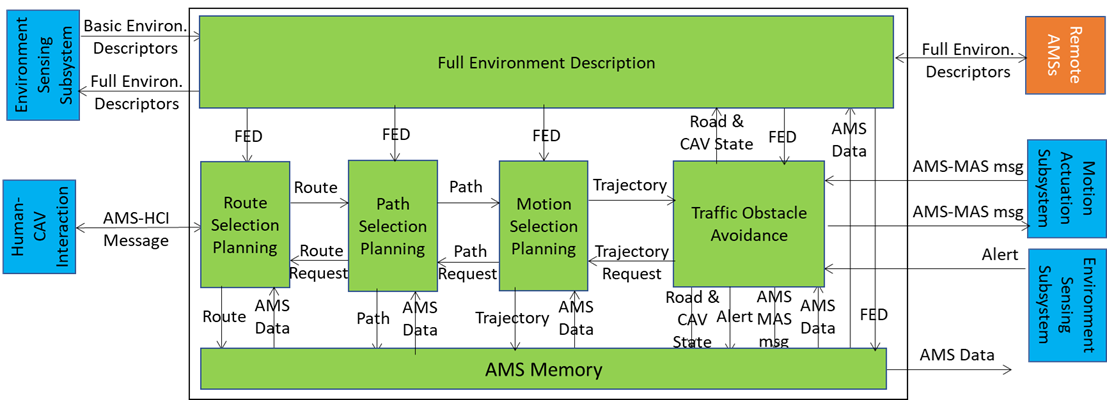
Figure 5 depicts the reference model of the Autonomous Motion Subsystem (AMS).
Reference Model of CAV-AMS

Figure 5 – Reference Model of CAV-AMS

When the Human–CAV Interaction Subsystem (HCI) sends the Autonomous Motion Subsystem (AMS) a request from a human or a process to move the CAV to a destination Point of View, Route Selection Planning uses the Basic Environment Descriptors provided by the Environment Sensing Subsystem (ESS) to generate a set of waypoints starting from the current Point of View.

When the CAV is in motion, Route Selection Planning triggers Path Selection Planning to generate a sequence of Points of View to reach the next waypoint. The Full Environment Description AI Module may request the AMSs of remote CAVs to provide subsets of their scene descriptors and integrates all environment descriptor sources into the Full Environment Descriptors (FED). It may also respond to similar requests from remote CAVs.

Motion Selection Planning generates a trajectory to reach the next Point of View along each path. Traffic Obstacle Avoidance receives the trajectory and checks whether any alert has been received that could lead to a collision with the current trajectory. If such a condition is detected, Traffic Obstacle Avoidance requests Motion Selection Planning to generate a new trajectory. Otherwise, Traffic Obstacle Avoidance issues an AMS–MAS message to the Motion Actuation Subsystem (MAS).

The MAS sends an AMS-MAS message containing information about the execution of the received command. Based on these messages, the AMS may discontinue the execution of a previous command, issue a new AMS–MAS message, and inform Traffic Obstacle Avoidance. The decisions made by each element in this chain may be recorded in the AMS memory (“black box”).

5      Motion Actuation Subsystem

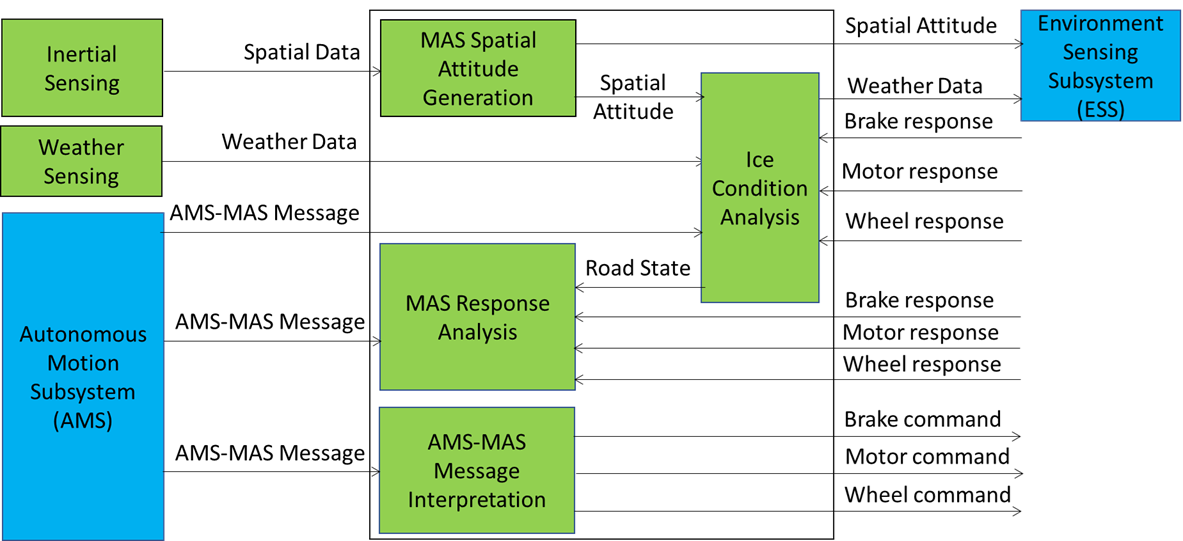
When the AMS Message Interpretation AIM receives an AMS‑MAS Message from the AMS, it interprets the message, partitions it into commands, and sends commands to the Brake, Motor, and Wheel subsystems as depicted in Figure 6.
Reference Model of CAV-MAS

Figure 6 – Reference Model of CAV-MAS

CAV-TEC does not specify how the three mechanical subsystems process commands. However, it defines the format of the responses issued to and received by the AMS Message Interpretation AI Module. The result of this interpretation is sent to the Autonomous Motion Subsystem (AMS) as an AMS-MAS message.

The Motion Actuation Subsystem includes additional AI Modules:

  1. Inertial Sensing, which includes devices such as odometers, speedometers, accelerometers, and inclinometers, and produces spatial data.
  2. Spatial Attitude Generation, which computes the initial spatial attitude of the ego CAV using the spatial data provided by Inertial Sensing. This initial spatial attitude is sent to the Environment Sensing Subsystem (ESS).
  3. Weather Sensing, which includes devices such as thermometers, hygrometers, anemometers, and others, and produces weather data.
  4. Ice Condition Analysis, which augments the weather data by analysing Brakes, Motors, and Wheels responses, and sends the augmented weather data to the ESS.


MPAI publishes Version 1.1 of “Connected Autonomous Vehicle – Technologies (CAV-TEC)”

Geneva, Switzerland – 10th June 2026. MPAI – Moving Picture, Audio and Data Coding by Artificial Intelligence – the international, non-profit, unaffiliated organisation developing AI-based data coding standards – has concluded its 69th General Assembly (MPAI-69) publishing Connected Autonomous Vehicle (MPAI-CAV) – Technologies (CAV-TEC) as MPAI Standard.

CAV-TEC V1.1 specifies the human-machine interaction, sensing, communication, reasoning, and control parts of a vehicle capable of driving autonomously with the support of information exchanged with other similar vehicles in range. It is based on the well-established AI Framework standard (MPAI-AIF) providing a secure environment suitable for the execution of independent processes called AI Modules, performing functions and exchanging data as specified by the CAV-TEC V1.1 Reference Model. The AI Framework enables interworking of independently developed AI-Modules, thus promoting the development of an open market for autonomous vehicle components.

CAV-TEC V1.1 will be presented online on the 1st of July 2026 at 16:00 UTC. Register here to participate

MPAI is continuing the development of its work plan that involves the following activities:

  1. AI Framework (MPAI-AIF): developing a Call for Technologies to extend the MPAI-AIF standard to enable a Remote Client Application to access a remote MPAI-AIF Controller, download and execute an AI Workflow, and access the result of the AIW processing.
  2. AI for Health (AIH-HSP): reviewing areas relevant for AI for Health and preparing for the development of Reference Software.
  3. Context-based Audio Enhancement (CAE-USC): developing the Audio Six Degrees of Freedom (CAE-6DF) and the Audio Object Rendering (CAE-AOR) standards.
  4. Connected Autonomous Vehicle (CAV-TEC): preparing for the development of Reference Software.
  5. Compression and Understanding of Industrial Data (CUI-CPP): developing a reference software implementation of CUI-CPP V2.0.
  6. End-to-End Video Coding (MPAI-EEV): exploring the potential of AI-based End-to-End Video coding in compressing video sequences.
  7. AI-Enhanced Video Coding (MPAI-EVC): exploring the possibility of a new standard for optimised down- and up-sampling filters..
  8. Governance of the MPAI Ecosystem (MPAI-GME): operating the MPAI Ecosystem per the MPAI-GME Specification.
  9. Human and Machine Communication (MPAI-HMC): exploring the use of AI in human-to-machine and machine-to-machine communication.
  10. Multimodal Conversation (MPAI-MMC): developing specifications of new data types especially in the context of the PGM-AUA standard.
  11. MPAI Metaverse Model (MMM-TEC): developing V2.2 of MMM-TEC with capabilities enabling virtual metaverse economies.
  12. Neural Network Watermarking (NNW-TEC): Reviewing new Neural Network Watermarking areas.
  13. Object and Scene Description (MPAI-OSD): developing specifications of new data types especially in the context of the PGM-AUA standard.
  14. Portable Avatar Format (MPAI-PAF): discussing the impact of MPAI standards planned or under development on MPAI-PAF V1.5.
  15. AI Module Profiles (MPAI-PRF): extending the scope of the current version of AI Module Profiles.
  16. Server-based Predictive Multiplayer Gaming (MPAI-SPG): exploring new standard opportunities in the domain.
  17. Data Types, Formats, and Attributes (MPAI-TFA) extending the standard to data types used by planned or under development MPAI standards.
  18. XR Venues (XRV-LTP): developing the standard for improved execution of Live Theatrical Performances using AI.

Legal entities and representatives of academic departments supporting the MPAI mission and able to contribute to the development of standards for the efficient use of data can become MPAI members.

Please visit the MPAI website, contact the MPAI Secretariat for specific information, subscribe to the MPAI Newsletter and follow MPAI on social media: LinkedIn, Twitter, Facebook, Instagram, and YouTube.


MPAI publishes “AI for Health – Health Secure Platform” and “Neural Network Watermarking – Technologies”

Geneva, Switzerland – 15th April 2026. MPAI – Moving Picture, Audio and Data Coding by Artificial Intelligence – the international, non-profit, unaffiliated organisation developing AI-based data coding standards – has concluded its 68th General Assembly (MPAI-68) publishing AI for Health (MPAI-AIH) – Health Secure Platform (AIH-HSP) and Neural Network Watermarking (MPAI-NNW) – Technologies (TEC) as MPAI Standards.

AIH-HSP enables End Users to use their Front Ends to capture, process, license, and upload health data to the system Back End where user-generated licences are converted into smart contracts, and their health data are processed per the smart contracts. From time to time the neural networks in the Front Ends are collected, updated using Federated Larning Technologies, and redistributed to End Users.         .

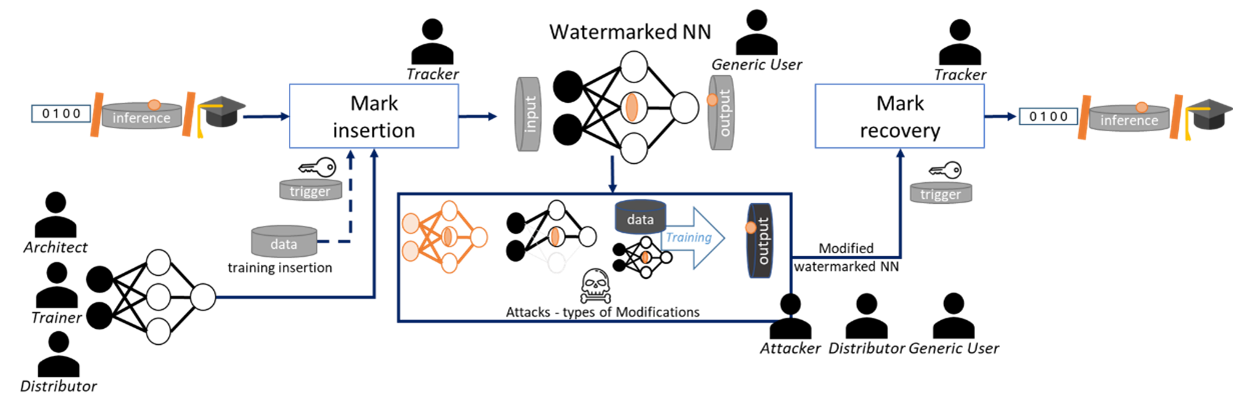
NNW-TEC utilises the previously approved Neural Network Watermarking – Technologies (NNW-NNT) standard to assess different watermarking technologies on a shared testbed.

MPAI-68 has also approved Version V1.1 of Connected Autonomous Vehicle (MPAI-CAV) – Technologies (CAV-TEC) as a draft standard published with a request for Community Comments until 2026/07/08. The focus is on ensuring security of the processing subsystem of the Connected Autonomous Vehicle.

MPAI is continuing the development of its work plan that involves the following activities:

  1. AI Framework (MPAI-AIF): developing a Call for Technologies to extend the MPAI-AIF standard to enable a Remote Client Application to access a remote MPAI-AIF Controller, download and execute an AI Workflow, and access the result of the AIW processing.
  2. AI for Health (AIH-HSP): reviewing areas relevant for AI for Health.
  3. Context-based Audio Enhancement (CAE-USC): developing the Audio Six Degrees of Freedom (CAE-6DF) and the Audio Object Rendering (CAE-AOR) standards.
  4. Connected Autonomous Vehicle (CAV-TEC): developing a new version of the flagship specification CAV-TEC with security support.
  5. Compression and Understanding of Industrial Data (CUI-CPP): developing a reference software implementation of CUI-CPP V2.0.
  6. End-to-End Video Coding (MPAI-EEV): exploring the potential of AI-based End-to-End Video coding in compressing video sequences.
  7. AI-Enhanced Video Coding (MPAI-EVC): exploring new standards that benefit from the use of Super Resolution filters.
  8. Governance of the MPAI Ecosystem (MPAI-GME): operating the MPAI Ecosystem per the MPAI-GME Specification.
  9. Human and Machine Communication (MPAI-HMC): exploring the use of AI in human-to-machine and machine-to-machine communication.
  10. Multimodal Conversation (MPAI-MMC): developing specifications of new data types especially in the context of the PGM-AUA standard.
  11. MPAI Metaverse Model (MMM-TEC): developing V2.2 of MMM-TEC with capabilities enabling virtual metaverse economies.
  12. Neural Network Watermarking (NNW-TEC): Reviewing new Neural Network Watermarking areas.
  13. Object and Scene Description (MPAI-OSD): developing specifications of new data types especially in the context of the PGM-AUA standard.
  14. Portable Avatar Format (MPAI-PAF): discussing the impact of MPAI standards planned or under development on MPAI-PAF V1.5.
  15. AI Module Profiles (MPAI-PRF): extending the scope of the current version of AI Module Profiles.
  16. Server-based Predictive Multiplayer Gaming (MPAI-SPG): exploring new standard opportunities in the domain.
  17. Data Types, Formats, and Attributes (MPAI-TFA) extending the standard to data types used by MPAI standards that are planned or under development.
  18. XR Venues (XRV-LTP): developing the standard for improved execution of Live Theatrical Performances using AI.

Legal entities and representatives of academic departments supporting the MPAI mission and able to contribute to the development of standards for the efficient use of data can become MPAI members.

Please visit the MPAI website, contact the MPAI Secretariat for specific information, subscribe to the MPAI Newsletter and follow MPAI on social media: LinkedIn, Twitter, Facebook, Instagram, and YouTube.


The novelties in the MPAI Metaverse Model – Technologies V2.2 standard

MPAI started addressing “metaverse” as a subject for standardisation in the early days of 2023 as an objective per se but also as an opportunity to integrate a plurality of technologies for which it had developed or was developing standards. After developing two Technical Reports exploring the issues, MPAI developed the MPAI Metaverse Model – Architecture (MMM-ARC) standard. This was followed by the MPAI Metaverse Model – Technologies (MMM-TEC) standards of which MPAI-66 has recently published Version 2.2.

In three years MPAI has invested significant resources in this project achieving important results. The initial MMM notions included things (Items) and beings (Processes) operating in a metaverse instance (M-Instance) under the responsibility of a human in conformity with the Rules of the M-Instance. Processes hold Rights on Items and Processes and can thus perform Actions on them. A Process may request another Process (e.g., a Service) to perform Actions on its behalf by issuing a Process Action. Twenty-eight Actions have been specified in terms of semantics, and more than 100 Items have been specified in terms of syntax (JSON Schema) and semantics. More than 50% of Items currently identified by MMM-TEC are defined by other MPAI Standards. The notion of Qualifier – metadata giving information such as format of an Item – has been fully adopted and integrated with the notion of a “Convert Service” to facilitate M-Instance interoperability as MMM-TEC does not impose any particular technology, such as for media.

MMM-TEC V2.2 inherits all the enabling technologies from preceding versions and enhances them with new technologies that provide full support for the establishment of virtual economies in an M-Instance.

This is the full list of finance-related Data Types specified by V2.2:

Acronym Name JSON Acronym Name JSON
MMM-ASS Asset X MMM-MKC Market Classes X
MMM-CTO Contract Object X MMM-PRV Provenance X
MMM-CUO Currency Object X MMM-SPM Service Pricing Model X
MMM-FBR Fault Behaviour Report X MMM-SCT Simple Contract X
MMM-FDR Fault Detection Report X MMM-TRA Transaction X
MMM-FER Financial Error Report X MMM-VAL Value X
MMM-LIC Licence X MMM-VMI Value Metadata IDs X
MMM-MPI Marketplace Policy IDs X MMM-WAL Wallet X

All MPAI specification entities – Data, AI Modules, and AI Workflows – are identified by six characters. The first three identify the standard (MMM in the case of Metaverse) and the remaining three the specific entity within that standard. Each entity (Data Types in this case) is specified in natural language on a specific web page (the table provides the links) and in a JSON Schema that may reference a Qualifier.

MPAI defines a “Simple Contract” that provides basic functionalities but also defines a Contract Object. The term “Object” indicates that the entity is composed of Data and a Qualifier. In the case of Contract, the Data are the contract, but the Qualifier specifies how to interpret the Data. MPAI acts as a Registration Authority that receives requests for new Contract Types not currently included in the Contract Qualifier.

The Asset Data Type is the key element of MMM-TEC finance. As for all MPAI Data Types, the natural language specification is subdivided into Definition (what the Data Type is for), Functional Requirements (the functionalities offered by the Data Type), Syntax (the JSON Schema), Semantics (the meaning of the data carried by an Asset Data Type instance), and Conformance Testing (how to test that an Asset Data Type instance is a correct implementation of the specification).

Let’s analyse what is inside the Asset Data Type, i.e., its semantics.

Label Description
Header Asset Header – Standard “MMM-ASS.Vx.y”
M-InstanceID Identifier of M-Instance.
M-Environment Identifier of a relevant Environment.
AssetID Identifier of the Asset.
SourceItemID Identifier of the Source Item that spawned the Asset.
AssetDate Timestamp of Asset creation.
Capabilities Declared process Capabilities and Rights (the Asset carries information on who holds which Rights to the Asset).
Provenance Information about the Asset provenance through a value chain.
MarketClass One of a set of categories of assets, rights, services, and experiences exchanged.
ValueMetadata Identifiers used to tag values associated with transactional or functional attributes.
CurrencyID Allowed currency type for pricing.
ServicePricingModel Rules, parameters, and conditions under which the Asset is offered, billed, chosen, settled, and accessed.
MarketplacePolicyID Identifier of the policy applied to listing, transaction, or operation of an Asset (Item or Service).
DataExchangeMetadata Metadata ensuring correct transfer of information from Source to Destination.
Trace Identity of the Process producing the Asset and its Time of production.
DescrMetadata Free-text metadata.

Of the elements in the first column, we will now concentrate on Service Pricing Model (SPM), a Data Type of high importance for establishing a virtual economy in an M-Instance. The following semantic table is much more structured, and so the specification of the different service pricing models has been simplified. The Asset Posting, Chosen, and Settlement parts retain the full details. The SPM Status label is used to signal the intermediate or final status of the Service Pricing Model.

Label Description
Header Service Pricing Model Header – Standard “MMM‑SPM‑Vx.y”.
MInstanceID Identifier of the M‑Instance.
MEnvironmentID Identifier of the M‑Environment.
SPMID Identifier of this Service Pricing Model instance.
SPMContext Whether this SPM describes a Service or an AssetPosting.
SPMTime Reference time for this SPM (OSD/V1.5 Time).
ModelType Primary pricing model: OneTime, Subscription, PayPerUse, PayPerTime, Freemium, Tiered, AdSupported, Hybrid (when combining multiple models).
CurrencyObject The currency for prices and values used in this SPM.
Models  
├─ OneTime One‑time purchase model.
├─ Subscription Subscription pricing data.
├─ PayPerUse Usage‑based (metered) pricing.
├─ PayPerTime Time‑window pricing.
├─ Freemium Freemium model.
├─ Tiered Tiered plan.
├─ AdSupported Ad‑supported access.
├─ Discounts[] Discount definitions.
└─ Hybrid[] Hybrid composition (combining sections).
AssetPosting Data for posting an Asset under this SPM.
├─ AssetID ID of the asset being posted.
├─ LicenceTerms Terms under which the asset is licensed.
├─ SenderPreValue Value before transaction.
├─ SenderPostValue Value after transaction.
├─ ReceiverPostValue Value after transaction for receiver.
├─ ValueToSender Final value to sender.
├─ SenderWalletID Wallet of sender.
├─ ServiceProviderWalletID Wallet of service provider (marketplace).
├─ ServiceProviderLicence Licence of service provider.
├─ ReceiverLicence Licence of receiver.
└─ Transaction Transaction.
Chosen Frozen snapshot of the chosen model and parameters.
├─ ModelType Chosen model type.
└─ Parameters Set of parameters at selection time.
├─ EffectivePeriod Validity window.
│ ├─ Start Start time.
│ └─ End End time.
├─ Allowances[] Frozen quota allowances.
│ ├─ Meter Meter type.
│ ├─ Unit Unit of measure.
│ ├─ Quantity Quantity allowed.
│ ├─ Window Applicable window label.
│ └─ Rollover Whether unused quota rolls over.
├─ Overage Overage pricing.
│ ├─ Rate Overage rate.
│ └─ Unit Overage unit.
├─ RateLimit Rate limiting constraints.
│ ├─ MaxPerWindow Maximum allowed per window.
│ ├─ Window Window size.
│ └─ Burst Burst allowance.
└─ PriceBreakdown Optional breakdown of base price, discounts, and final charges.
Settlement Payment proof for the SPM‑governed transaction.
├─ SettlementTime Time of settlement.
├─ TargetID Identifier of relevant Service/Asset/Licence.
├─ Transaction Transaction reference.
└─ Evidence[] Optional receipts or provider references (Type, ID).
SPMStatus Either “Model” or “Final”.
DataExchangeMetadata Regulated/controlled exchange metadata.
Trace Information about the Process producing the SPM and the time of production.
DescrMetadata Free‑text descriptive metadata (≤ 2048 chars).

Version 2.2 specifies the protocols used by a Process when it requests another Process to perform a Process Action.

Here we describe the MM-Add protocol used by a Process to request a Locate Service to place an Item at a Location.

  1. User sends MM-Add Process Action (PA) Request including Item, Point of View, Location, and Rights (Status=Model).
    1. If MM-Add is a free service, goto MM-Add.
    2. If MM-Add is a pay service:
      1. User sends MM-Add PA Request with Service Pricing Model (Status=Model) to the Locate Service of which MM-Add is an element.
      2. Locate sends MM-Add PA Response:
        1. If MM-Add PA Response includes Status=Err, goto End
        2. If MM-Add PA Response includes Status=Ack and Service Pricing Model including Transaction (both Status=Model), User:
          1. Transacts Value contained in Transaction.
          2. Sends MM-Add PA Request with Service Pricing Model (Status=Model) including Transaction (Status=Final) to MM-Add.
        3. MM-Add: Locate
          1. MM-Adds Item.
          2. Sends MM-Add PA Response (to requesting Process) including
            1. Rights (Status=Final) for MM-Added Item.
            2. Service Pricing Model (Status=Final), if MM-Add is a pay service.
          3. End.

As you see, the Service Pricing Model is used as the vehicle to finalise the relationship between the Requesting Process and the Locate Service.

MMM-TEC V2.2 will be presented at the online event held on on 9 April 2026 at 16 UTC. Register here to attend.


MPAI as a Service (MaaS) for a new generation of intelligent services

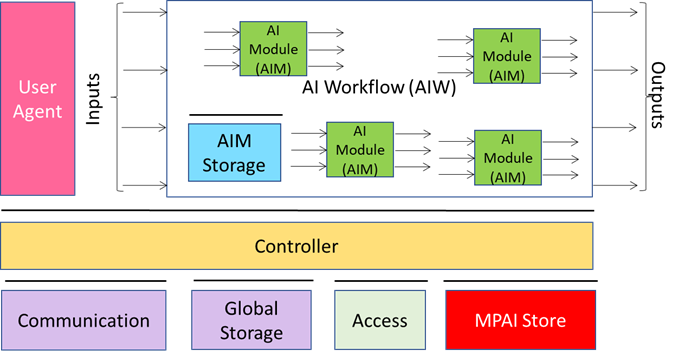
The 66th MPAI General Assembly (MPAI-66) has approved the publication of the “MPAI as a Service” Call for Technologies. To get a proper understanding of the positioning of this new standard in the MPAI Ecosystem, we should recall the basic elements of the AI Framework (MPAI-AIF) and the Governance of the MPAI Ecosystem (MPAI-GME) standards. The former specifies an environment where it is possible to initialise, dynamically configure, and control AI applications called AI Workflows (AIW) composed of connected processing elements called AI Modules (AIM). MPAI-AIF specifies two profiles – a Basic and a Security Profile.

Figure 1 depicts the MPAI-AIF Basic Profile Reference Model. You can see the Controller – the brain of the system – and the MPAI-AIF APIs enabling the Controller to obtain AIWs/AIMs from the MPAI Store, the place where implementers can submit their implementations for distribution after they have been tested for conformance with the standard and verified for security. Once the AI Framework is equipped with the desired domain-specific processing capabilities, the User Agent can activate the Controller, and the AIMs can call it via the appropriate APIs.

Figure 1 – Reference Model of MPAI-AIF Basic Profile

Let’s explore how things can unfold in this new scenario.
1       Creation of infrastructure

Creation of infrastructure is the responsibility of the deployment/control plane to avoid access to the application data plane by the control plane and vice-versa. The REST API protocol is used to specify the steps.

1.1      Connection to the SCI

SCI specifies the required security protocols that the RCA must employ for authentication and authorisation purposes. AIF should include an exemplary list of security protocols (basic, digest, bearer). The connection is required by all subsequent points and must be secured using one of the proposed security schemes described in End Point Open API.

1.2      Creation of an SCI

RCA asks the AIF end point for the creation of one or more SCIs to which all subsequent AIF API requests will be issued. The objective of SCI creation is the acquisition of an SCI identity for use in subsequent API requests to identify the intended SCIs among the many to which the message will be directed.

1.3      Workflow discovery

RCA submits a request to the Server API for AIW matching and discovery. The resulting collection of Workflow Descriptions is returned to the RCA for ultimate selection.

1.4      Launch of the desired AI Workflow

RCA submits a request to the SCI through the AIF end point for the launch of the desired AIW(s). The objective of Workflow launch is the acquisition of a Remote Workflow Instance (RWI) identity for use in subsequent API requests for identification of the intended AIW among the many with which input/output messages will be exchanged.

2       Message Exchange

Application data exchange is the responsibility of the application data plane thus ensuring non-exposure of application data to the control plane. The REST API protocol is used to specify the steps.

2.1      Delivery of messages to the input ports of the AI Workflow

RCA submits requests to the above-identified SCI, through the AIF end point for the delivery of AIF Messages containing application data to the desired input port(s) of the RWI(s).

2.2      Reception of messages from the output ports of the AI Workflow

RCA may submit requests to the above-identified SCI through the AIF end point for the reception of AIF Messages from the desired output port(s) of the launched RWI(s). The RCA makes provision for asynchronous delivery of the response when required.

2.3       Termination of infrastructure

The deployment/control plane is responsible for the avoidance of access to the application data plane by the control plane and vice-versa. The REST API protocol is used to specify the steps.

3    Termination

3.1      Termination of the AI Workflow

RCA submits requests to the SCI through the AIF end point for the termination of the RWI(s).

3.2      Release of the AIF Controller

RCA submits requests to the AIF end point for the termination of the above-identified SCI(s).


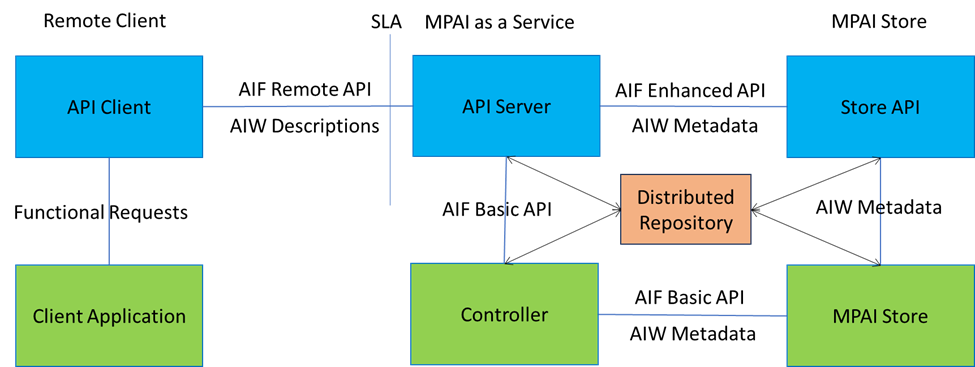
Figure 2 depicts an initial Reference Model of MPAI as a Service.

Figure 2 – MPAI as a Service Reference Model


An overview of the complete workflow is given by:

  1. The RCA issues a request through the API Client to the API Server for the creation of an SCI.
  2. The API Server acts as a local User Agent of a Controller.
  3. The API Server returns the ID (created by the API server) of the newly created SCI to RCA.
  4. The RCA issues a request via the API Client through the API Server to the indicated SCI for the instantiation of a named AIW (RWI).
  5. The SCI retrieves the named AIW metadata (describing the AIW) from the MPAI Store and then parses, retrieves, and installs the referenced packages as required for the instantiation of the AIW.
  6. The MPAI Store receives requests from the SCI for delivery of AIW metadata and the subordinate packages that collectively describe the complete AIW.
  7. The MPAI Store returns the requested elements if it possesses them, otherwise it issues requests to the appropriate remote repositories so as to retrieve the missing elements. The MPAI Store could be:
    1. As simple as a stand-alone web server responding to HTTP Get requests.
    2. Based on a distributed file system management service, such as HDSF and other variations.
    3. Based on a standard cloud object management and delivery service, such as Amazon S3 or Open Stack Swift.
    4. Fronted by an object authenticity management framework, such as The Update Framework.
    5. Any combination or variation of the above.
  8. The API Server returns the AIW ID, which was provided by the SCI to the RCA.
  9. The RCA issues a request via the API Client through the API Server to the indicated SCI for delivery of the accompanying input data message to the specified Port of an AIM of the indicated AIW.
  10. The RCA issues a request via the API Client through the API Server to the indicated SCI for reception of an output data message from the specified Port of an AIM of the indicated AIW.
  11. The API Server returns to the RCA the output data message received from the specified Port of an AIM, which was provided by the indicated SCI.
  12. The RCA issues a request via the API Client through the API Server to the indicated SCI for the termination of the RWI.
  13. The RCA issues a request via the API Client to the API Server for the termination of the indicated SCI.

To leverage the availability of AIMs and AIWs from various sources, MaaS requires that:

  • The access to the MPAI Store be ubiquitous to support envisaged application scenarios.
  • The highest level of authorisation be guaranteed by the SCI to an RCA when accessing AI Workflows and their constituent components.
  • The highest level of authenticity control be exercised by the SCI on AI Workflows and their constituent packaged components.\

MPAI-66 has issued a Call for Technologies requesting interested parties to propose:

  • An architecture for the management of the MPAI Store and the subordinate distributed repositories.
  • Protocol(s) that are considered suitable for supporting the above requirements.
  • Alternatively, a single interface enabling SCIs to access a plurality of repositories each supporting different protocols.
  • If needed, proposals for revision of the MPAI-AIF Basic API, to accommodate requirements of the proposed technologies.

Solutions proposed may be original, or rely on existing technologies, or be any integration thereof.

The MaaS Call will be presented at two online events held on 2026/03/30 at 8:00 UTC (register here to attend) and 15:00 UTC (register here to attend).


MPAI publishes the “MPAI as a Service” Call for Technologies and the MPAI Metaverse Model V2.2 standard for Community Comments

Geneva, Switzerland – 18th March 2026. MPAI – Moving Picture, Audio and Data Coding by Artificial Intelligence – the international, non-profit, unaffiliated organisation developing AI-based data coding standards – has concluded its 66th General Assembly (MPAI-66) publishing a Call for Technologies regarding the planned “MPAI as a Service” (MaaS) standard and MPAI Metaverse Model – Technologie (MMM-TEC) V2.2.

MPAI as a Service is the code name of the target service that would make it possible for a client application to access sophisticated AI processing services by launching an AI Workflow downloaded from the MPAI Store by a remote MPAI AI Framework (MPAI-AIF) processing environment. The Call requests technologies that leverage the MPAI-AIF Application Programming Interface for the reduction of the MPAI Store traffic when downloading AI Workflow components, such as bulky neural network models, from the required certified distributed repository servers.

The next steps are:

  • Register to attend the 30 March online presentations of the Call at 8:00 and 15:00
  • Submit a response to the Call to the MPAI Secretariat by 13 April at 16 UTC.
  • Start the MPAI as a Service standard development on 15 April (MPAI-67).

MPAI-66 has also reached another important milestone with the publication of Version 2.2 of the now well-established  MPAI Metaverse Model – Technologies (MMM-TEC) standard. This new version adds a major set of technologies enabling the deployment of a sophisticated virtual economy and a new open-source implementation of MMM-TEC based on OpenSimulator. The standard is published with a Request for Community Comments until 11 May. Learn about the opportunities offered by the new MMM-TEC version by registering to attend the public online presentation on 9 April at 15:00 UTC.

MPAI is continuing the development of its work plan that involves the following activities:

  1. AI Framework (MPAI-AIF): developing a Call for Technologies to extend the MPAI-AIF standard to enable a Remote Client Application to access a remote MPAI-AIF Controller, download and execute an AI Workflow, and access the result of the AIW processing.
  2. AI for Health (AIH-HSP): reviewing the specification of a system receiving and processing licenses AI Health Data and enabling clients to improve health processing models via federated learning.
  3. Context-based Audio Enhancement (CAE-USC): developing the Audio Six Degrees of Freedom (CAE-6DF) and the Audio Object Rendering (CAE-AOR) standards.
  4. Connected Autonomous Vehicle (CAV-TEC): developing a new version of the flagship specification CAV-TEC with security support.
  5. Compression and Understanding of Industrial Data (CUI-CPP): developing a reference software implementation of CUI-CPP V2.0.
  6. End-to-End Video Coding (MPAI-EEV): exploring the potential of AI-based End-to-End Video coding in compressing video sequences.
  7. AI-Enhanced Video Coding (MPAI-EVC): exploring new standards that benefit from the use of Super Resolution filters.
  8. Governance of the MPAI Ecosystem (MPAI-GME): operating the MPAI Ecosystem per the MPAI-GME Specification.
  9. Human and Machine Communication (MPAI-HMC): exploring the use of AI in human-to-machine and machine-to-machine communication.
  10. Multimodal Conversation (MPAI-MMC): developing specifications of new data types especially in the context of the PGM-AUA standard.
  11. MPAI Metaverse Model (MMM-TEC): developing V2.2 of MMM-TEC with capabilities enabling virtual metaverse economies.
  12. Neural Network Watermarking (NNW-TEC): Refining the new Neural Network Watermarking (MPAI-NNW) – Technologies (NNW-TEC) standard published for Community Comments.
  13. Object and Scene Description (MPAI-OSD): developing specifications of new data types especially in the context of the PGM-AUA standard.
  14. Portable Avatar Format (MPAI-PAF): discussing the impact of MPAI standards planned or under development on MPAI-PAF V1.5.
  15. AI Module Profiles (MPAI-PRF): extending the scope of the current version of AI Module Profiles.
  16. Server-based Predictive Multiplayer Gaming (MPAI-SPG): exploring new standard opportunities in the domain.
  17. Data Types, Formats, and Attributes (MPAI-TFA) extending the standard to data types used by MPAI standards that are planned or under development.
  18. XR Venues (XRV-LTP): developing the standard for improved execution of Live Theatrical Performances using AI.

Legal entities and representatives of academic departments supporting the MPAI mission and able to contribute to the development of standards for the efficient use of data can become MPAI members. New members joining before 31st December 2025 have their membership extended until 31st December 2026.

Please visit the MPAI website, contact the MPAI Secretariat for specific information, subscribe to the MPAI Newsletter and follow MPAI on social media: LinkedIn, Twitter, Facebook, Instagram, and YouTube.


MPAI request Community Comments on its Neural Network Watermarking Technologies V1.0 standard

Geneva, Switzerland – 18th February 2026. MPAI – Moving Picture, Audio and Data Coding by Artificial Intelligence – the international, non-profit, unaffiliated organisation developing AI-based data coding standards – has concluded its 65th General Assembly (MPAI-65) publishing the Neural Network Watermarking – Technologies (NNW-TEC) V1.0 standard with a request for Community Comments.

Technical Specification: Neural Network Watermarking – Technologies (NNW-TEC) V1.0  assesses specific NN Traceability technologies with respect to Imperceptibility, Robustness, and Computational Cost using the methodologies specified by the previously approved Neural Network Watermarking – Traceability (NNW-NNT) V1.1 standard. NNW-TEC offers the industry a path to obtain results of Imperceptibility, Robustness, and Computational Cost evaluations for specific Neural Network Traceability Technologies based on standard evaluation methods.

There are several ways to know more about the standards:

Comments of NNW-TEC V1.0 shall reach the secretariat by 13 April 2026.

MPAI-65 has also decided to publish the Company Performance Prediction (CUI-CPP) V2.0 standard in final form.

MPAI is continuing the development of its work plan that involves the following activities:

  1. AI Framework (MPAI-AIF): developing a Call for Technologies to extend the MPAI-AIF standard to enable a Remote Client Application to access a remote MPAI-AIF Controller, download and execute an AI Workflow, and access the result of the AIW processing.
  2. AI for Health (AIH-HSP): revising developing the specification of a system receiving and processing licenses AI Health Data and enabling clients to improve health processing models via federated learning.
  3. Context-based Audio Enhancement (CAE-USC): developing the Audio Six Degrees of Freedom (CAE-6DF) and the Audio Object Rendering (CAE-AOR) standards.
  4. Connected Autonomous Vehicle (CAV-TEC): developing a new version of the flagship specification CAV-TEC with security support.
  5. Compression and Understanding of Industrial Data (CUI-CPP): developing a reference software implementation of CUI-CPP V2.0.
  6. End-to-End Video Coding (MPAI-EEV): exploring the potential of AI-based End-to-End Video coding in compressing video sequences.
  7. AI-Enhanced Video Coding (MPAI-EVC): exploring new standards that benefit from the use of Super Resolution filters.
  8. Governance of the MPAI Ecosystem (MPAI-GME): operating the MPAI Ecosystem per the MPAI-GME Specification.
  9. Human and Machine Communication (MPAI-HMC): exploring the use of AI in human-to-machine and machine-to-machine communication.
  10. Multimodal Conversation (MPAI-MMC): developing specifications of new data types especially in the context of the PGM-AUA standard.
  11. MPAI Metaverse Model (MMM-TEC): developing V2.2 of MMM-TEC with capabilities enabling virtual metaverse economies.
  12. Neural Network Watermarking (NNW-TEC): Refining the new Neural Network Watermarking (MPAI-NNW) – Technologies (NNW-TEC) standard published for Community Comments.
  13. Object and Scene Description (MPAI-OSD): developing specifications of new data types especially in the context of the PGM-AUA standard.
  14. Portable Avatar Format (MPAI-PAF): discussing the impact of MPAI standards planned or under development on MPAI-PAF V1.5.
  15. AI Module Profiles (MPAI-PRF): extending the scope of the current version of AI Module Profiles.
  16. Server-based Predictive Multiplayer Gaming (MPAI-SPG): exploring new standard opportunities in the domain.
  17. Data Types, Formats, and Attributes (MPAI-TFA) extending the standard to data types used by MPAI standards that are planned or under development.
  18. XR Venues (XRV-LTP): developing the standard for improved execution of Live Theatrical Performances using AI.

Legal entities and representatives of academic departments supporting the MPAI mission and able to contribute to the development of standards for the efficient use of data can become MPAI members. New members joining before 31st December 2025 have their membership extended until 31st December 2026.

Please visit the MPAI website, contact the MPAI Secretariat for specific information, subscribe to the MPAI Newsletter and follow MPAI on social media: LinkedIn, Twitter, Facebook, Instagram, and YouTube.


Improved Health Services with AI

The 64th MPAI General Assembly has approved publication of Technical Specification: AI for Health (MPAI-AIH) – Health Secure Platform (AIH-HSP) V1.0 with a request for Community Comments to be received by the MPAI Secretariat by 16 March 2026. This paper gives an overview of the proposed standard introduction to help those who wish to review and comment on AIH-HSP.

The Health Secure Platform specifies the architecture of a platform offering health-related services enabling the following functionalities:

  1. End Users use AIH-HSP Apps running on their Front Ends (personal devices) to acquire Health Data.
  2. Health Data, combined with an associated Model Licence, are called AIH Data.
  3. AIH Data is uniquely identified.
  4. AIH Data is processed by the Front End using an instance of the MPAI-specified AI Framework (MPAI-AIF).
  5. Front End processes AIH Data using AI-for-Health-recommended AI Modules (AIM) downloaded from the MPAI Store.
  6. Neural Networks in AIMs continually learn while making inferences on AIH Data.
  7. Un-processed and Processed AIH Data are uploaded to the AI Back End.
  8. Back End stores the Model Licence as a Smart Contract on a Blockchain associated with the Back End.
  9. A Smart Contract ID is added to the AIH Data.
  10. The Smart Contract governs the use that is made of the AIH Data stored on the Back End.
  11. Depending on the relevant Smart Contract, an instance of AIH Data stored on the Back End may be processed by the Back End itself and Third-Party Users.
  12. The Back End may process End Users’ AIH Data in its local AI Framework based AI Data Processing AIM.
  13. A rich AIH Taxonomy includes:
    1. AIH Data Classes (currently: ECG, EEG, Genomics, and Medical Images).
    2. AIH Data Users (currently: End User, Non-Profit Entity, Profit Entity, Clinical Entity, Authorised Entity, Caregiver).
    3. AIH Data Statuses (currently: Anonymised, Pseudonymised, Identified).
    4. AIH Data Usages (currently: Unrestricted, Pseudonymised, Anonymised, Research, Patient use, Health care).
    5. AIH Data Processing Types (currently: ECG, EEG, Genomics, Medical Images).
    6. Anonymisation/De-Identification Algorithms.
    7. Anomaly Types.


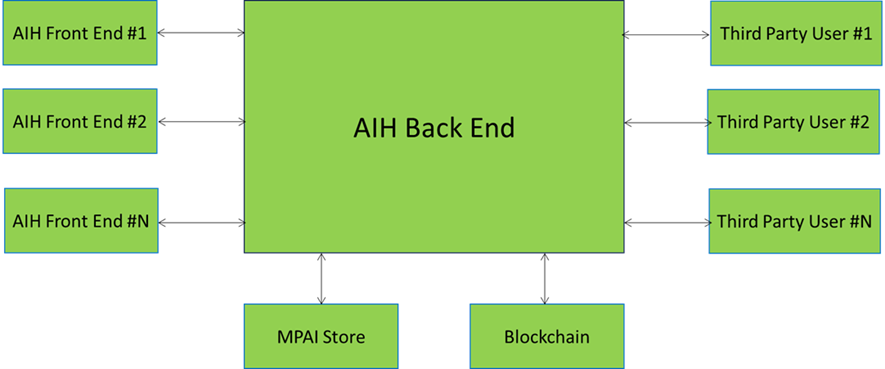
Figure 1 depicts the Health Secure Platform specified by AI for Health. At the centre there is the Back End to which Front Ends and Third-Party Users are connected. The MPAI Store enables Back End and Front Ends to access the AI Modules they need for their processing. The Blockchain manages the licencing terms provided to it by the Model Licence.

Figure 1 – General Model of AIH-HSP V1.0


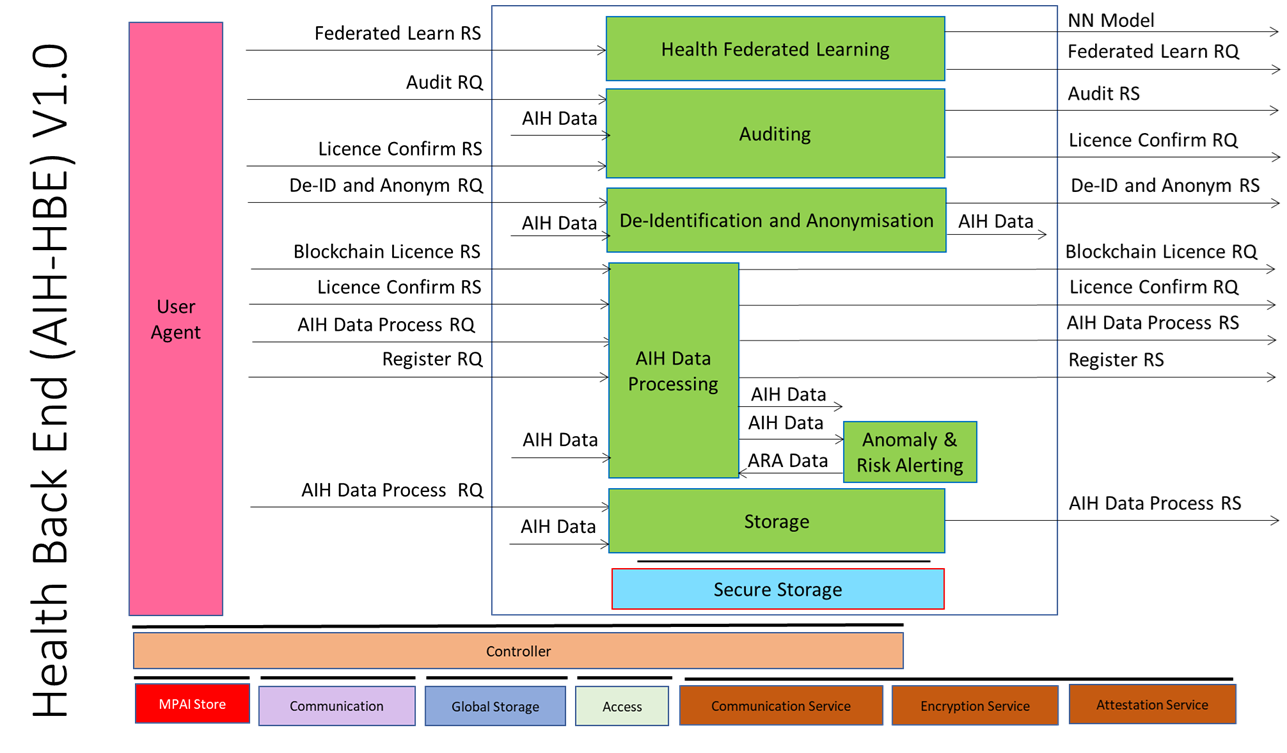
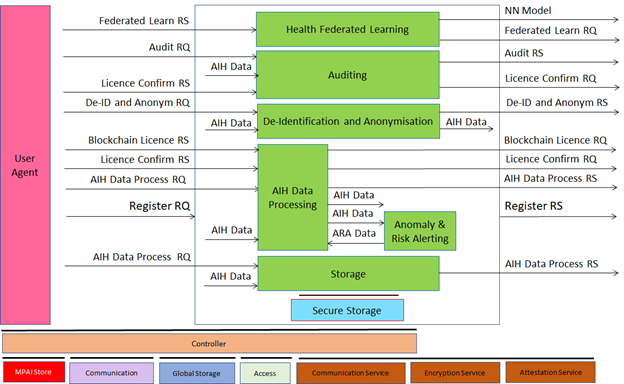
Figure 2 depicts the architecture of the AIH Back End where Back End, End User, Blockchain, and Third-Party Users perform operations.

Figure 2 – Reference Model of the Health Back End (AIH-HBE) AIW


  1. Back End accesses the MPAI Store and downloads the AIMs required for its operation.
  2. User Registration
    1. A User wishing to access the Back End, sends a Registration Request containing Personal Profile and list of Service they intend to access.
    2. Back End provides the Tokens enabling the requesting User to access the corresponding Services.
  3. Storage of AIH Data
    1. End User uploads AIH Data.
    2. HBE Data Processing
      1. Extracts Model Licence from AIH Data.
      2. Issues Blockchain Licence Request to Blockchain.
    3. Blockchain
      1. Converts Model Licence to a Smart Contract.
      2. Responds with a Blockchain Licence Request.
    4. HBE Data Processing
      1. Attaches Blockchain Licence ID to AIH Data.
      2. Stores AIH Data in Secure Storage
    5. De-Identification/Anonymisation (DIA) of AIH Data
      1. End User sends a DIA Request.
      2. HBE Data Processing
        1. Retrieves relevant AIH Data from Secure Storage.
        2. (Pseudo-)Anonymises AIH Data.
        3. Stores (Pseudo-)Anonymised AIH Data back to Secure Storage.
        4. Responds with a DIA Response.
      3. AIH Data Processing
        1. User sends AIH Process Request.
        2. HBE Data Processing sends a Licence Confirm Request to the Blockchain.
        3. Blockchain responds with a Licence Confirm Response.
        4. HBE Data Processing
          1. Performs the requested Processing, if this is included in the Licence.
          2. Stores the Processed AIH Data as new AIH Data.
          3. Responds with an AI Data Process Response.
        5. Audit
          1. End User sends Audit Request.
          2. Auditing
            1. Retrieves relevant Confirmation Responses to verify that all Processing was performed according to the Licence terms.
            2. Responds with Audit Response.
          3. Federated Learning
            1. Federated Learning sends Federated Learning Request to all Health Front Ends.
            2. Health Front Ends provide the NN Models.
            3. Federated Learning
              1. Develops and upload the new NN Model to the MPAI Store.
              2. Sends Federated Learning Response to Health Front Ends.
            4. Front Ends download the new NN Model from the MPAI Store.

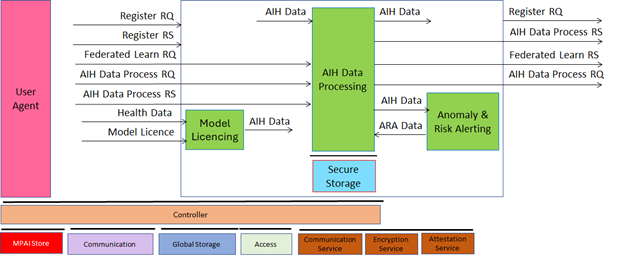
Figure 3 depicts the Reference Architecture of the Health Front End (AIH-HFE) where Front End and End User perform operations.

Figure 3 – Reference Model of the Health Front End (AIH-HFE) AIW


  1. End User registers with HFE and HBE.
  2. End User acquires Health Data with a Health Device and provides Model Licence.
  3. Model Licencing AIM attaches Model Licence to Health Data, produces AIH Data and Stores AIH Data.
  4. End User processes AIH Data locally.
  5. End User stores AIH Data to HFE.
  6. End User processes AIH Data remotely on the Back End.
  7. HFE receives Federated Learn request.
  8. HFE sends the NN Model trained since last Federated Learn request to HBE.


The AIH-HSP V1.0 standard is available. An online presentation will be made on 2026/02/09 T15 UTC. Register to attend.

Comments on AIH-HSP V1.0 shall reach the MPAI Secretariat by 2026/03/16.


MPAI publishes the AI for Health V1.0 standard with a Request for Community Comments

Geneva, Switzerland – 21st January 2026. MPAI – Moving Picture, Audio and Data Coding by Artificial Intelligence – the international, non-profit, unaffiliated organisation developing AI-based data coding standards – has concluded its 64th General Assembly (MPAI-64) publishing the AI for Health V1.0 standard.

Technical Specification: AI for Health (MPAI-AIH) – Health Secure Platform (AIH-HSP) V1.0  envisages that AIH-HSP subscribers use personal devices running AI Framework implementations (front ends) to locally process and submit health data to the AIH-HSP back end. A licence attached to health data specifies the types of processes that the back end or specific organisations called Third-Party Users may perform and the type of use they can make of the process data. The back end is connected to a blockchain storing the smart contracts governing the processes that the back end and the Third-Party Users can perform on subscriber data. From time to time, the backend collects neural networks trained by front ends and distributes an updated neural network used by AIH-HSP subscribers with the knowledge acquired by the community using Federated Learning.

There are several ways to know more about the standards:

MPAI is also publishing V2.4 of Context-based Audio Enhancement (MPAI-CAE) – Use Cases (CAE-USC).

MPAI is continuing the development of its work plan that involves the following activities:

  1. AI Framework (MPAI-AIF): extending the MPAI-AIF specification to enable a client to access a remote MPAI-AIF Controller and an AI Module to communicate data to another AIM with associate metadata.
  2. AI for Health (AIH-HSP): developing the specification of a system receiving and processing licenses AI Health Data and enabling clients to improve health processing models via federated learning.
  3. Context-based Audio Enhancement (CAE-USC): developing the Audio Six Degrees of Freedom (CAE-6DF) and the Audio Object Rendering (CAE-AOR) specifications.
  4. Connected Autonomous Vehicle (CAV-TEC): developing a new version of the flagship specification CAV-TEC with security support.
  5. Compression and Understanding of Industrial Data (CUI-CPP): expecting comments on the Company Performance Prediction V2.0 specification.
  6. End-to-End Video Coding (MPAI-EEV): exploring the potential of AI-based End-to-End Video coding in compressing video sequences.
  7. AI-Enhanced Video Coding (MPAI-EVC): exploring new standards that benefit from the use of Super Resolution filters.
  8. Governance of the MPAI Ecosystem (MPAI-GME): operating the MPAI Ecosystem per the MPAI-GME Specification.
  9. Human and Machine Communication (MPAI-HMC): exploring the use of AI in human-to-machine and machine-to-machine communication.
  10. Multimodal Conversation (MPAI-MMC): developing specifications of new data types especially in the context of the PGM-AUA standard.
  11. MPAI Metaverse Model (MMM-TEC): developing security-enabling protocols in the MMM-TEC specification.
  12. Neural Network Watermarking (NNW-TEC): Developing the new Neural Network Watermarking (MPAI-NNW) – Technologies (NNW-TEC) including assessments of Neural Network Traceability Technologies.
  13. Object and Scene Description (MPAI-OSD): developing specifications of new data types especially in the context of the PGM-AUA standard.
  14. Portable Avatar Format (MPAI-PAF): discussing the impact of MPAI standards planned or under development on MPAI-PAF V1.5.
  15. AI Module Profiles (MPAI-PRF): extending the scope of the current version of AI Module Profiles.
  16. Server-based Predictive Multiplayer Gaming (MPAI-SPG): exploring new standard opportunities in the domain.
  17. Data Types, Formats, and Attributes (MPAI-TFA) extending the standard to data types used by MPAI standards that are planned or under development.
  18. XR Venues (XRV-LTP): developing the standard for improved execution of Live Theatrical Performances using AI.

Legal entities and representatives of academic departments supporting the MPAI mission and able to contribute to the development of standards for the efficient use of data can become MPAI members.

Please visit the MPAI website, contact the MPAI Secretariat for specific information, subscribe to the MPAI Newsletter and follow MPAI on social media: LinkedIn, Twitter, Facebook, Instagram, and YouTube.